DIY: safari made out of a shoe box

safarism3

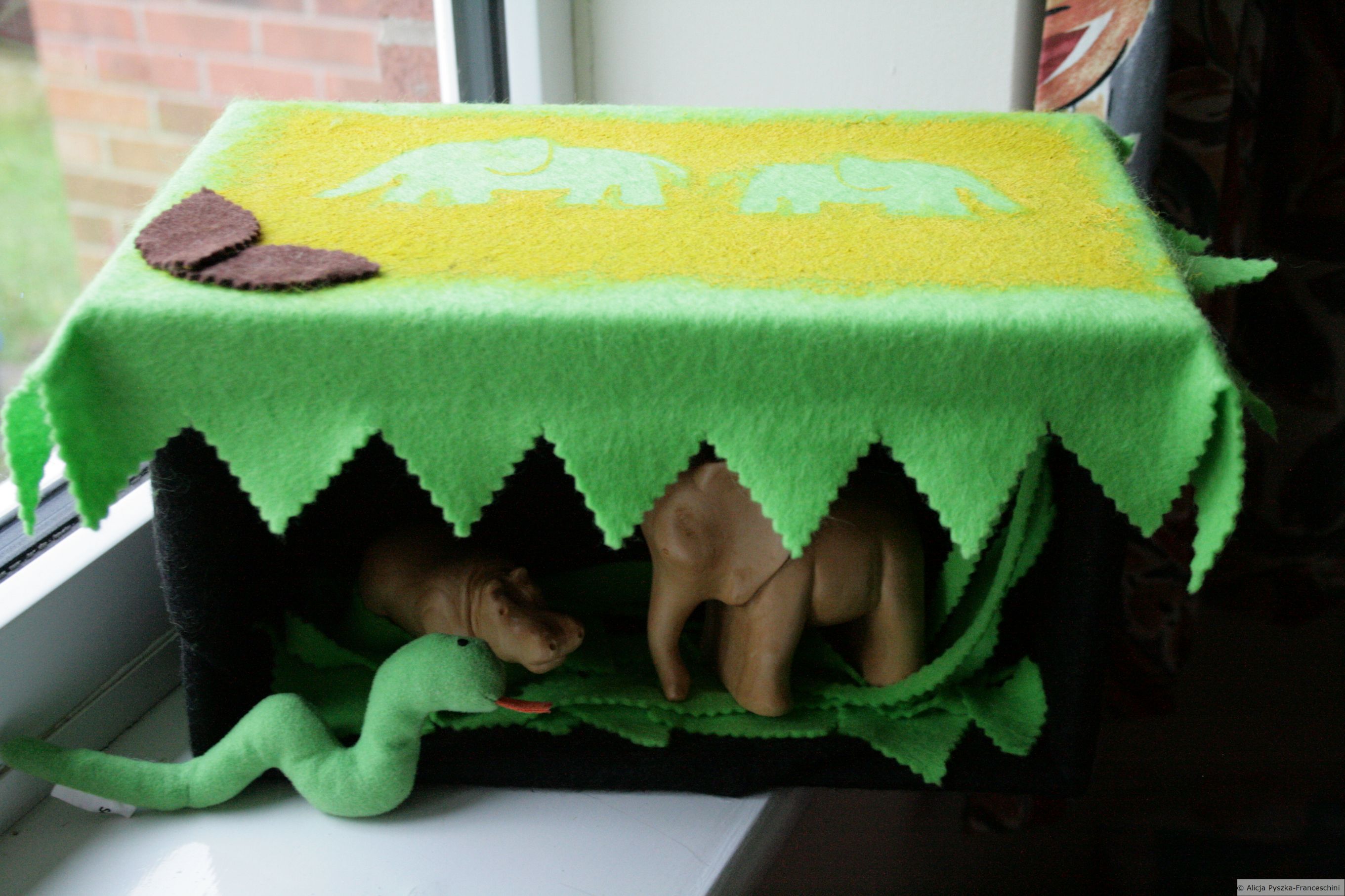
Buying nothing new is not only about shopping. It is also about making use of what we have in our houses already. I had a shoe box and quite a bit of felt from my craft projects that I did as far back as two years ago. I decided to make something out of them. When I started I wasn’t sure what it will be… I thought that the fabric and scissors will lead me somewhere and I was right… it was quite a journey… a safari in fact.

First I ironed the felt that I wanted to use. Then I tightly covered the box with black felt and folded it diagonally to make nice and clean looking creases. I used big binder clips to help me with fabric adjustments. Once I knew how the fabric would cover the bottom part of the box I started unfolding bits of felt and gluing them back to the box with a double-sided adhesive tape. I glued the felt onto all the walls of the box and inside the box too.

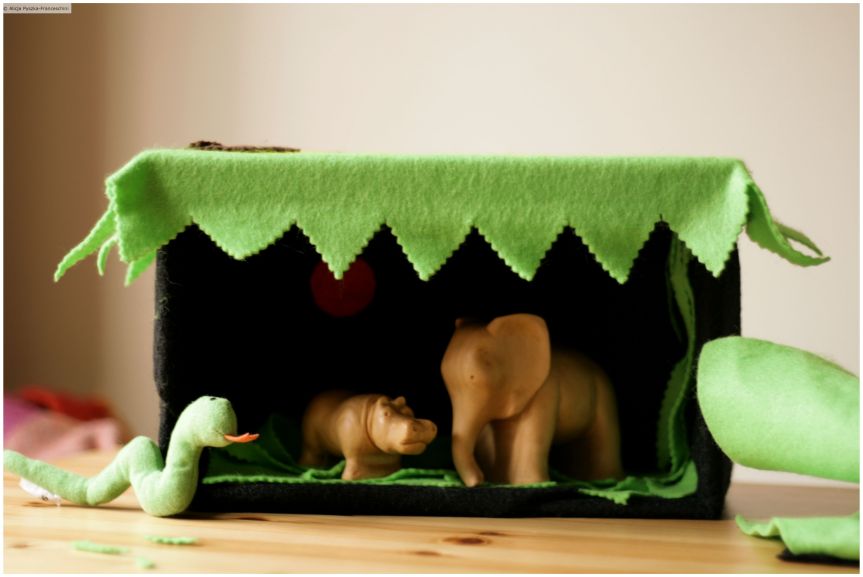
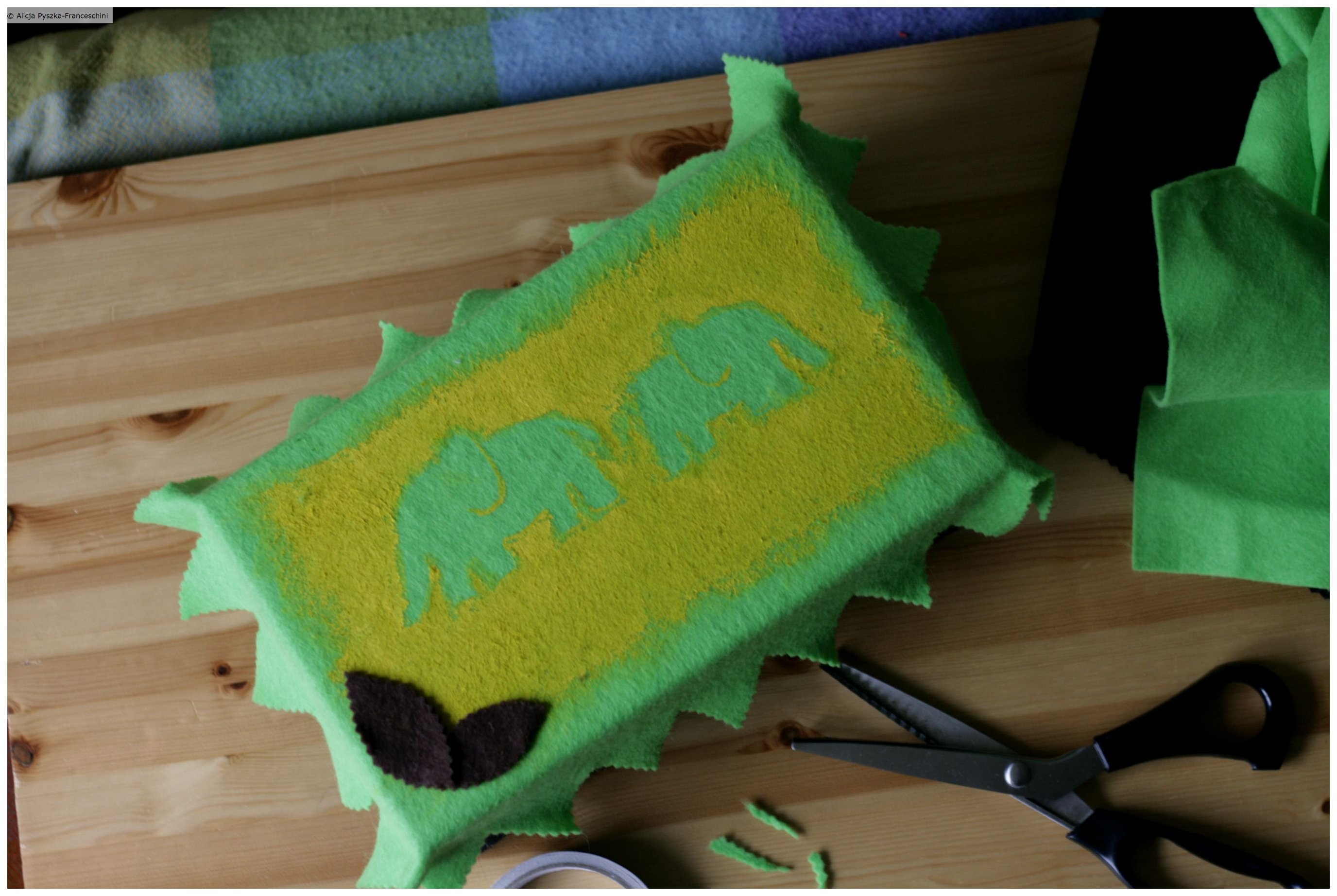
I used green felt to cover the top of the box.  I glued the felt to its flat horizontal surface and its side walls using the double-sided adhesive tape again. Around 3 cm of felt was hanging down from the side walls of the cover. I cut out small triangles on this hanging fabric using the pinking shears. And this is when I decided that it’s going to be a safari box. I left the off-cuts to use them for the grass and foliage inside it.

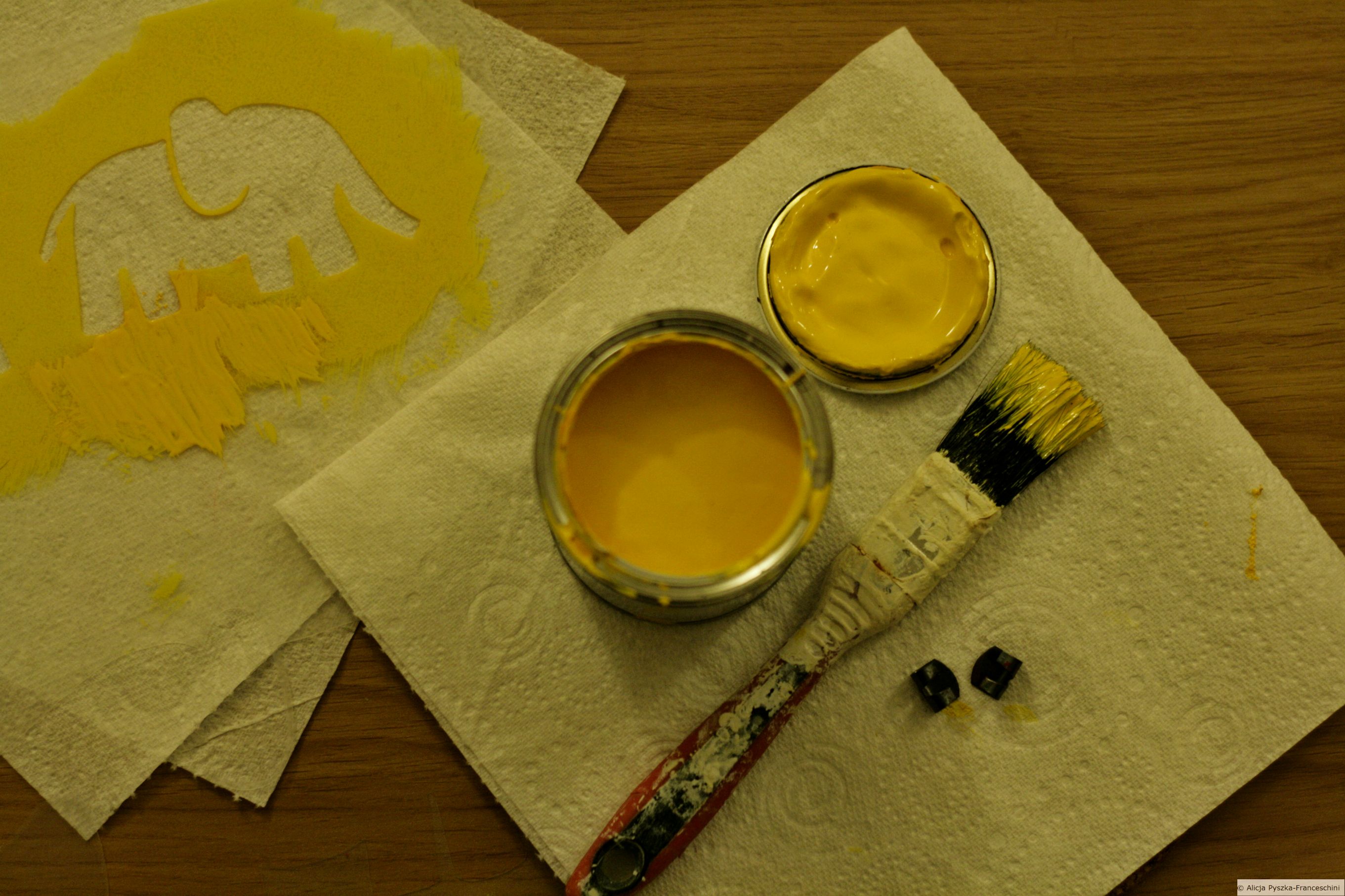
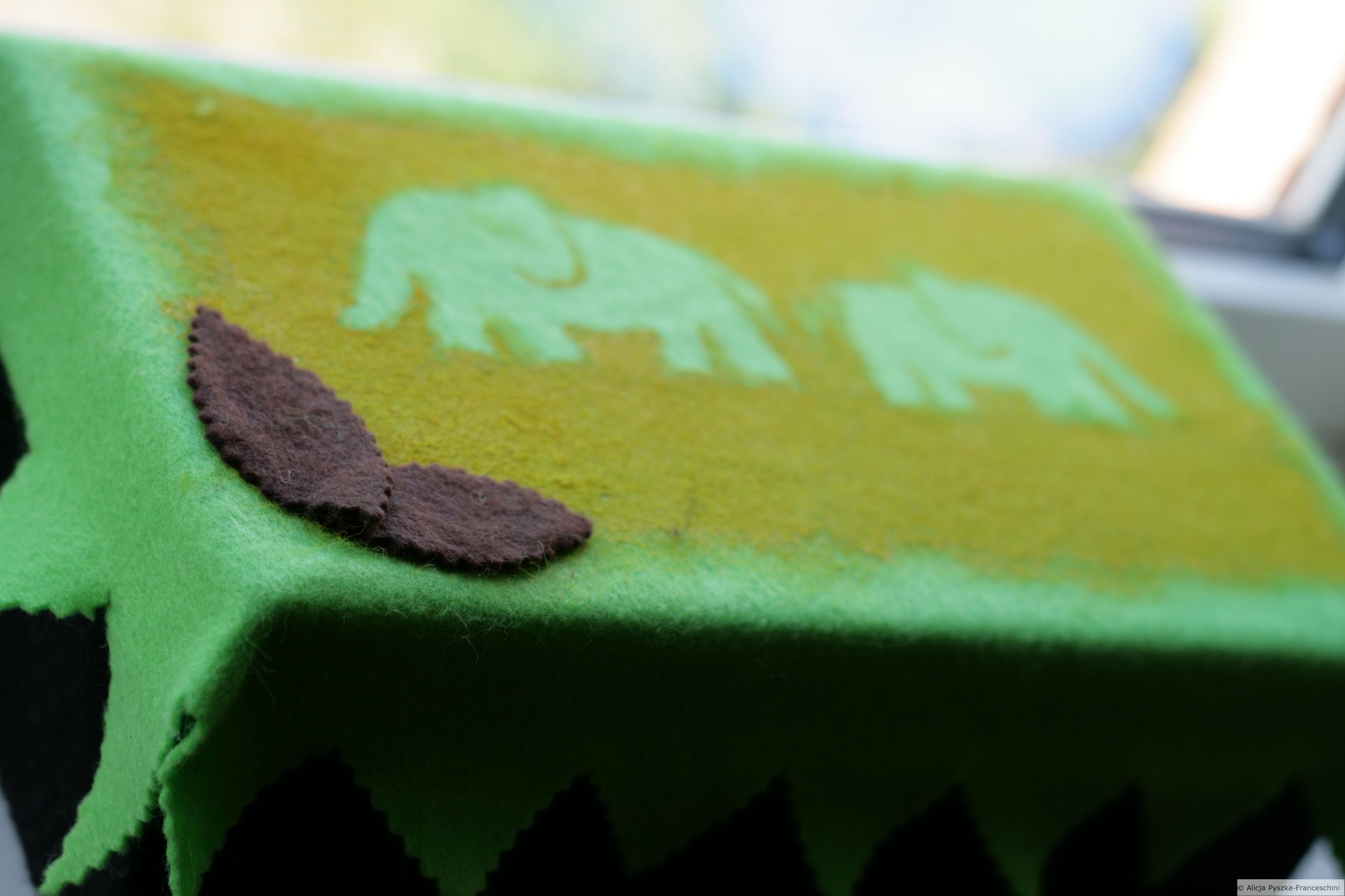
I remembered about an elephant stencil that I had in one of my books ( Stencils by Lotta Jansdotter) and decided to use it on the box. I tried it first on paper but it didn’t work very well when I wanted to fill the cut out with paint so instead I decided to use yellow paint on its edges and make an imprint on the cover. I corrected the imprint on the cover when it was required. (If you would like to do it for yourself you can just cut an elephant, a heart or a flower out of paper and try to paint around the edges. It will give the same effect.)

Next, I cut out two leaves out of brown felt and glued them to the cover.

I flipped the box on its side, glued the remaining scraps of the green felt to the bottom of the box and onto its one side. Cut out a red circle and glued it to the back to make it look like the sun. I looked for some animals in my son’s toy collection and placed them in the scene. (These can be made of paper too. No need to buy special animals for it.) Placed the box cover on top and here it is… a lovely safari to play with. Perfect for a good pretend play with your child or between your children during a rainy or sunny afternoon. :)

All I used was:

iron, 1 shoe box, felt in 3 different colours, self-adhesive tape, yellow paint, an elephant stencil, large binder clips, pinking shears and small toy animals (nothing new was bought for this project)

Safari przybory

folding felt making a safari boxadding colour and elephantsleavessafarism3safari smgrass and leaves

Nothing New Challenge was started by Sash at Inked in Colour. Have you visited her blog recently? It’s the most amazing place online I’ve come across so far. Have a peek, it’s well worth it.

Let the story unfold…

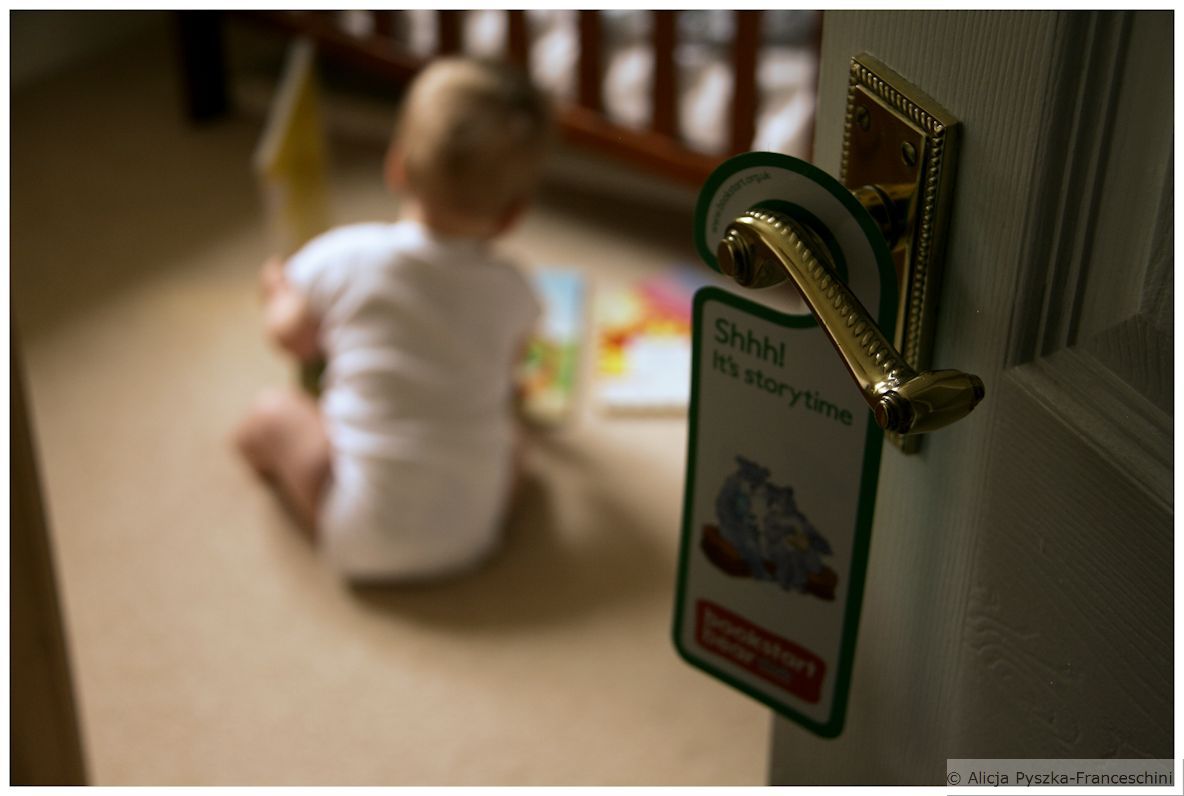
Storytime_a toddler reading a bookI always cared about books. A book was the very first thing that I bought for my son even before I got his first baby grow. Books are integral to our family life. Our spaces seem incomplete without them and our days somewhat deprived if a book is not read or heard being read.

I never had many preconceptions about motherhood or about having a family. But there was always one thing that I didn’t want for my child. I never wanted to create a home where stories are not read, not told, not re-enacted or not invented. I never wanted books to be just lonely physical objects perched on shelves. In fact, I often felt sorry for those children who are given wonderful gifts of tales and fables and nothing is done with them… where those presents are really never unwrapped for them which means that the stories for these children never come to life. This is such a waste. Isn’t it true that to a large extent stories shape childhood? The stories we read, the stories we tell, the stories we repeat…. they make an impact on our child’s character and on the ways in which they perceive the world around them and their own role in it… Stories warn, stories educate, stories entertain and comfort… Stories remain when we are gone.

That first book that I purchased two years ago… There was a wonderland in that book. And I wanted my son to be transported there. There was vibrancy and strength in that book. And I wanted him to be energized by it. There was a meaning within the story. I wanted him to remember its message. And mainly there was joy… a pure joy that I sensed would emerge from engaging with it. A break. For my son and for me. Joyful, peaceful and energizing break.

Mothering with books is a form of simplified parenting. You allow the books to do the hard work of showing, telling, instructing and in many cases they are probably more effective than we are. It’s just much easier to follow a story than a parent. This year I am not buying any books but I am writing stories and poems because I see them as crucial for my son’s development. I see them as essential for his imagination, health and playtime. Without them I wouldn’t be myself and my son would not have the childhood that he deserves to have.

I know I am just a mum of a toddler… of a boy who cannot engage with an elaborate story yet and who frankly has just only recently moved on from the stage of book eating to actually being able to listen to the story. You may think that reading is not really that significant at this stage… that stories do not make as much impact…Well.. you see… I look at this small child and I look at the way he handles his books and I see a very strong need in him… the need to engage with the world that’s presented on those pages… the need to know, the thirst to understand… those small things such as why the little chicken is pulling a bucket full of water from the well or why the small kitten is in bed with a high temperature. How can you not tell the whole story when those small eyes are pleading to know?

The shop with a difference

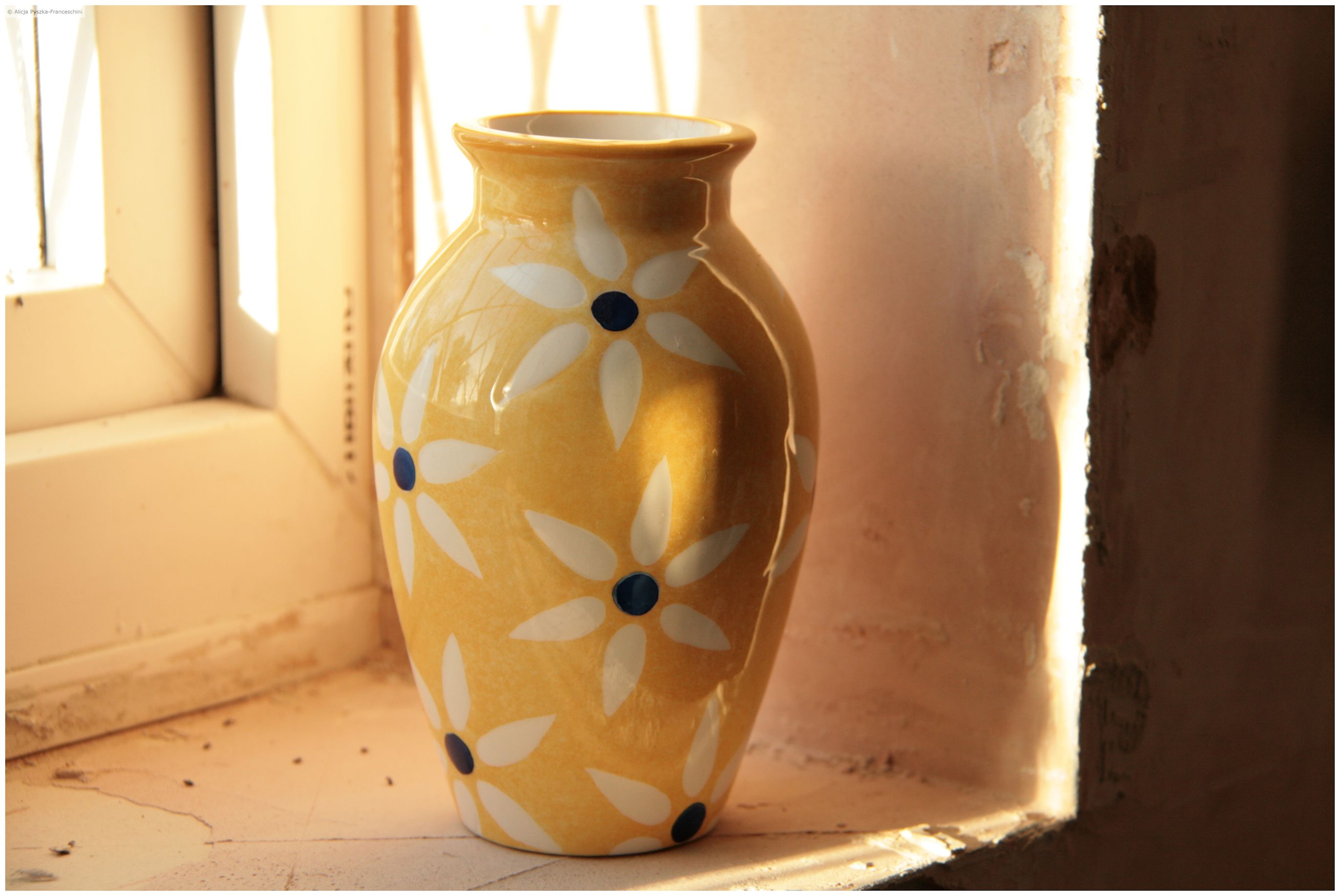
Vase from a charity shop

There are over ten thousand charity shops in the UK. They sell mainly second-hand goods donated to them from any and every generous soul. You just turn up with your bag or box filled with small treasures and hand it over to the person that’s behind the counter. By selling your products, the shop raises funds for its parent charity. Or you can just simply shop there.

There’s a surprisingly large circle of people that are made happy through your give-aways to the charity shop. A) You are happy because you have done a good deed B) Your family is happy because you have eventually removed that unused-and-dumped-in-the-corner irritating cast away of an item C) The charity workers feel less lonely in their quest for good-doing – you provide them with evidence that there is quite a handful of open-hearted characters in their proximity (and how encouraging and uplifting it is to know that your town is full of generous beings!) D) The beneficiaries of the parent charity (no explanation needed here) E) The charity-shop customer who has just found what he has been looking for for ages and just a day before gave up hope of finding it F) The customer’s partner, friend and family that are going to be experiencing relief after the lucky find.

I do have a few nice things that caught my eye while I was visiting the shops. The vase above is one of them. It looks quite nice in our still-not-ready and rough-looking kitchen.

Do you shop or give to charity shops? Is there anything precious that you found there? Or maybe you are planning to visit a charity shop this weekend? What cause do you support?

Consumers or Producers?

Life in the countryside

In the last few days my mind has moved on from a personal approach to consumerism to its broader aspect. I am thinking of our enormous (societal) ability to consume beyond the level of shopping.

I’ve been greatly privileged with being brought up in the countryside… in a village full of farms, orchards, green and golden fields. The images that I carry in my head are those of hard-working people, of people who care greatly and of people who produce and make every effort at creating quality foods for others. I’ve been observing people who dedicate their days, holidays and weekends to making sure that whatever piece of land they own will yield the desired crop… that they have something to offer to the world once the summer finishes. This isn’t done without sacrifice. It does take a lot out of them… but somehow I cannot imagine them doing anything else… they just grow up with that mindset… that mentality… that you are worth as much as you can offer to others.

This ability and eagerness to produce for others seems to have slipped out of the Western psyche. We’ve been too contented with being consumers for ourselves. It’s not only about the economical dimension but also about personal and social aspects. How much do we give from ourselves to others? How far are we able to extend ourselves? How creative and how hard-working are we?

I think that at least in our purchasing choices, if that is possible, we should not be driven by the price tag only. We ought to be more community-spirited when it comes to shopping. This is so important! To make the region that you live in a sustainable source of nourishment and growth. I stand for buying local. I try to support as many shops and farms in the area where I live as possible as I feel I am not entitled to complain about the economic situation in my local area if I don’t actively support its economy. I feel responsible for doing my share.

This countryside mindset also compels me to ask myself: To what extent am I a producer? What do I produce? What can I produce? With the abilities that I have been given, how can I support my family, society, friends and the environment? How can I be of value to the communities that I inhabit? Are there areas where I am only a consumer? Can I change it? Should I change it? Have I struck the right balance? So many questions to learn from..

Orchard

Seeing the luxurious

Beauty in the basket

There is a Spanish saying: Mejor solo que mal acompañado, which literally means Better alone than in bad companionship. I always thought that this is true of relationships. That a good relationship, be it friendship, romantic partnership or a work team, reflects the beauty of everyone in it. No one is overshadowed. No one is dwarfed. No one is suppressed. The same is true of objects that fill our homes and other spaces. Their beauty is revealed either when they stand alone or in the right company.

There are many items in my house which have lost their charm either because they’ve been swamped by other stuff or have been overshadowed by bigger or gaudier objects. I’ve started giving space to those little beauties by de-cluttering the house or just altering their arrangement. I’ve learnt through making these small improvements that recognizing the luxurious is all about this… about seeing and presenting things as luxurious although they are common, normal, average, typical and trivial.

Things that are given space stand out. We perceive them as special and we take notice of them. If you think of luxury and beauty in those terms it is almost impossible to have a life that is deprived of them. In that sense, you are never poor. It’s just about perception.. about having the eye that’s willing to see beauty in simplicity… it’s about having or training the beautiful eye.

“As you simplify your life, the laws of the universe will be simpler, poverty will not be poverty, nor weakness weakness”

~Henry David Thoreau

orchidred box and a cherrySimple beauty

By the way, have you recently visited any of these blogs: #BehindtheLens or Capturing Little Moments? One of my favourite beauty-spotters recently.