Part 3: Sink or swim in a crumble (on photographing food in a small kitchen with frozen shoulders and busy kids around).

If you mention a crumble to a Polish person, they would most likely very instinctively say that in Poland we have something quite similar but it is called ‘drożdżówka’ and it is actually a yeast-based cake that we often make with plumbs (or other fruit) when summer fades away and autumn takes charge of the table.

‘Drożdżówka’ has been always the treat that came out of my aunty’s oven every Sunday after the eleven o’clock mass that our priest always struggled to conclude. Hands were getting colder, legs were getting restless and as our stomachs were rapidly shrinking in size, our souls were working out their patience. Nourished with the Word of God, we either ran to our car or rushed to the pavements in hope for a piece of cake and a warming cup of hot coffee at my aunty’s place. ‘Niech Będzie Pochwalony Jezus Chrystus’ (May Lord Jesus Christ be Praised) was what used to be boldly exclaimed entering her kitchen. ‘Na wieki wieków, Amen’ (Now and ever shall be) was the reply. Interestingly, I observe, these words are slowly exiting our Polish culture as I hear us often saying ‘I’m back’ instead of the customary Christian greeting. I like the Christian greeting and it seems to me that our Sunday ritual is not entirely completed without those words. Ethnographers tend to notice these shifts in language patterns quite quickly just as they would note changes in how cakes are made. ‘Drożdżowka’ has changed and evolved in those Polish houses everywhere where the dietary requirements kicked in or other preferences are taking over, like losing weight, for instance.

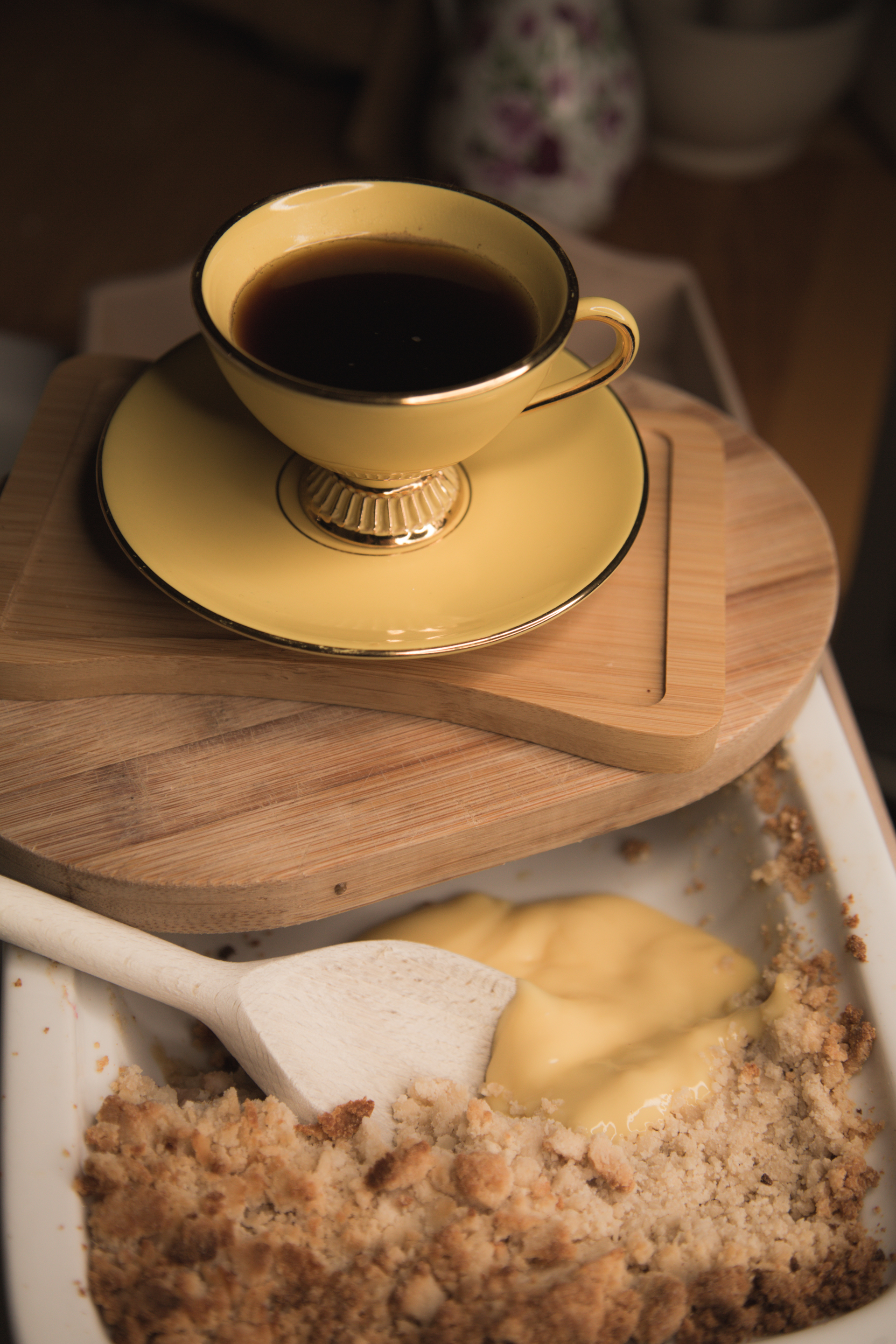
The English crumble, I feel, is what is replacing this cake in families such as ours where gluten and egg whites, cow’s milk are off the menu and yeast should be avoided. Now, of course, there are hundred of ways in which crumble can be made and eaten. The one that I photographed here was made with apples and pears, honey (from my dad’s beehives), cinnamon, gluten free flour, coconut flour and coconut oil. I must admit I feel a bit like Willy Wonka by showing you photos of a dessert for a second-week in a row and I worry that the police will come and fetch me for introducing sweets to the city, but I am sure that you understand it very well that it is all done in the good faith of preserving childhood dreams and mother’s sanity as photographing it and writing it all up in a small kitchen with two frozen shoulders is not a small effort. ;)

So last week I had these questions in mind/ obstacles while photographing:

– how to photograph the food when the kids want to eat it straight away

– how to photograph left overs or food partially eaten in a manner that is acceptable to the eye but at the same to preserve the sense of realism

– how to make use of the sink

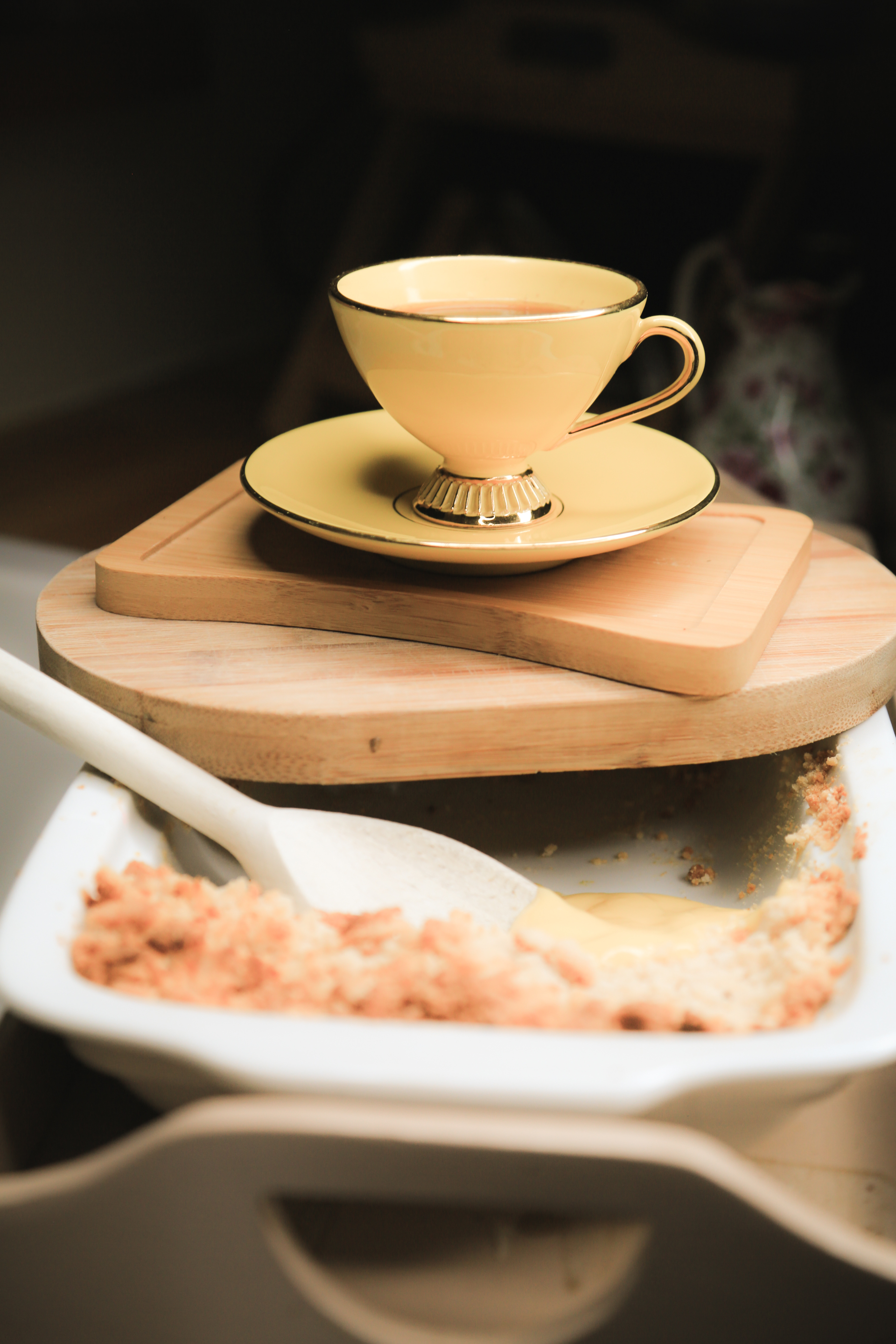
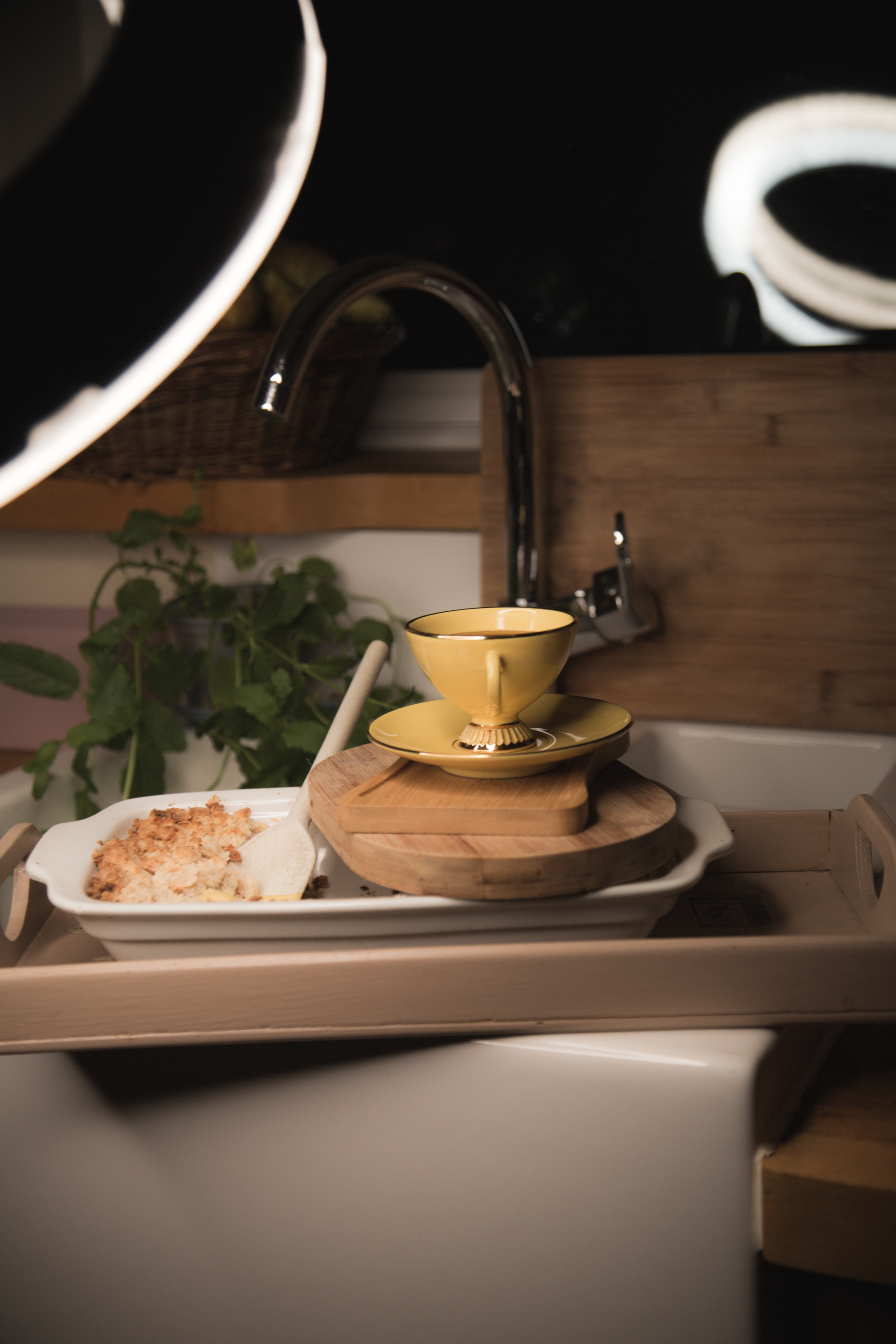
Essentially, I had this problem that we ate too much of it and too quickly but in all honesty waiting is difficult with hungry kids and all that you can do is to ask them to leave at least some for later or spoon some out before serving to preserve it for the photo (which comes in handy even a day after when you come back home from a cold walk and crave for some warming food). The crumble was lovely, but it resembled more of a pie than a crumble, I guess, because there was quite a lot of the dough. The dish was fairly flat, made of porcelain, rectangular and white. The very first thing that I thought of was that there would need to be a separation between the white colour of the dish and the white of the sink for a clearer composition so I decided to put it on a decoupaged beige tray that a differnt aunt of mine gave me a few years ago. I placed the dish with the tray in the sink for some photos to see what the effect would be with the white frame around the decoupaged try but in the end I like the one that sat higher on the edge of the sink as it gave me more depth to the background. The bits stuck to the side of the crumble pie dish were visible and quite unsightly so I decided to colour match the custard with a small towel and I placed it on the right side of the dish to cover the crumbs. That was done for the close-up. For a broader view, I looked for an additional item in the kitchen that again would somewhat decorate the food and take attention away from the fact that it was gluttonously devoured. I had this elegant chipped little coffee cup that I thought would take the attention and I placed it on a few wooden trays to give it prominence and posture. To complete the picture I used Contrastly autumn calm filters to give it it a calming and relaxing mood and feel – I wanted to evoke a feeling of calm after storm, one that you experience once the children are asleep and guests have gone home, and you are just on your own cleaning the kitchen. I included here also a backstage photo with my ring light for you to see how I positioned the light. I was taking the photos while standing on the left, just behind the ring light. On the backstage photo, the cup’s hand is directed at you. This is a compositional mistake. I remember a long time ago, I attended a course on children photography with Elena Shumilova and I couldn’t understand why one of the photos that I took of my daughter was compositionally worse than other ones. In that photo my daughter was sitting sideways and her elbow was somewhat lifted. Elena explained to me that it looked as if she was elbowing the viewer’s eye and in a way this is exactly what this cup appears to do in this backstage photo. It looks as if it was trying to elbow you so it is not the desired and the intended composition for a pleasing shot. Just the backstage photo. :)
Back to the topic of crumbles, last Sunday we visited Bradgate Park in Leicestershire and we stopped at the Coach&Horses for Sunday meal before the walk. Their crumble was a much healthier version to ours, I feel, as it had I think almost a triple the amount of fruit and it had less flour. As a result, theirs was a less fatty option to choose from. Avoid ours. But give photography at least an afterthought… :)

What have you been making recently?

Till now.

Alicja

P.S. I found heat patches to be very useful in easing my pain in the shoulders while I lift the camera up and while I hold it. I am using these ones at moment: Deep Relief Heat Patches. They might be useful to you too.
Beauty equals…

lily

“The real sin against life is to abuse and destroy beauty, even one’s own – even more one’s own, for that has been put in our care and we are responsible for its well-being.” Katherine Anne Porter, journalist and author

I’ve been trying to position myself towards the topic of beauty for a long time now. I have been brought up in a home that did not celebrate beauty. “Beauty is only skin-deep” was probably the most often used statement about beauty that I heard as a child. It was of course used in order to show that assigning importance to looks is superficial but I think that more often than not we were quite confused about the statement. Because if it was superficial and we generally should not care about it, why did we have to look good when we were visiting relatives?

Anyhow, ‘Beauty is only skin-deep’ was a saying that many liked to sing when we were growing up and, to be honest, I see it now as more damaging to children’s understanding and appreciation of beauty than helpful in building their characters. What I do not like about this saying is that it discredits beauty per se, it discredits the need for looking after it, it discredits the need for creating it and if said too often, it basically stops us from looking after the beauty that we are surrounded with and the beautiful people that we are.

Beauty requires effort. It takes work and purposeful, regular practice to create it. It also takes knowledge and dedication. I only truly understood this through my life experiences over the last few years: growing a child, making things for our house and garden, writing and photographing. What I have learnt is that beauty thrives with care and creativity and care and creativity entail effort. Creativity is effort, it’s seeing details, it’s being able to mould materials until they take the shape that we want them to take, it’s also about learning how beauty is made and about practice. It’s about spending time and often exerting ourselves to reach the outcome that we want to have, and finally it’s about tending to it regularly, taming it’s wildness. Beauty can be shallow but usually it is not. Usually beauty is work. It’s a lot of work nurtured with love and affection.

Shouldn’t we therefore teach our children that beauty should be respected rather than disparaged?

The more affection we have towards who we are, what is within us and what is around us, the more beautiful…

everything becomes.

The universe got it right by giving us the seasons

homeThe wind has started blowing a bit harder and the sun escapes from view much earlier these days. But home feels so cosy and just right for staying in. I like our home. I love the books scattered around the house, the remains of our toddlers’ adventures that need scooping up towards the end of each day, the fruit and vegetables in the baskets in our kitchen, even the sink still filled with pots from today’s cooking episodes. I think the universe got it right by giving us the seasons. The late autumn and winter and the cosiness that we experience of our own homes – doesn’t it support one view? That where we are is home. That where we are now we should be now, at this given moment in time. That everything is as it should be.

I will be using this winter to grow the same level of cosiness in my heart and look for every feeling in me that sends this warmth to the world and back to myself and my family.

What do you do to cultivate warm feelings?

Be good to yourself. Learn.

kind_unkind learning

“Be good to yourself when you are learning new things.” ~ Elizabeth Gilbert

The longer I study and research, the more I am convinced that developing an inner voice that is kind makes learning less painful and more satisfying.

Kind learning is reassuring, encouraging and full of small and sweet inspirations that help us move forward. It’s this voice which formulates convincing answers to discouraging questions. This kind and eager learning voice which encourages us to enter because the water is just the right depth for us.

The voice of kind learning seeks bigger pictures and deeper meanings. It wants us to answer questions beyond the formulaic: ‘Where do you see yourself in five years time?’. It wants to know: ‘What are your values?’ ‘What do you really care about?’.  It wants us to find the authentic self and for this we ought to learn self-compassion, to learn how to be reassuring and openly honest with ourselves – seeing all of our life journey as crucial to the making of who we are. When we work and learn with our values in mind, it all starts to take shape, it starts to feel right.

“Don’t ask what the world needs. Ask what makes you come alive, and go do it. Because what the world needs is people who have come alive.” ― Howard Thurman

Parenting with (Self)Care: Guides and Links To Resources on Postnatal Health, Wellbeing and Nutrition

poppies are gone_copy

Nutrition and postnatal health are the topics that I have, over the last two years, become very interested in. In nutrition because I want my husband and son to be healthy; in postnatal health because I want to be able to enjoy these challenging early years of motherhood. I’ve been reading a lot around those subjects but also attending meetings and events in my town that addressed those topics. I am one of these people that need to be reminded and frequently directed on to the right path if I want good habits to settle in.

Here’s a list of resources that helped me…

The essential guide to foods that heal, Olivier, Suzannah [ISBN: 978-0716023272]. It is actually unbelievable how many ailments can be healed or exacerbated by the food that we eat. This guide is clear, well-written and packed with information. It’s a spring of knowledge that is really worth drinking from.

The 10 Secrets of 100% healthy people, Holford, Patrick [ISBN: 978-0749929114]. Don’t be dissuaded by the strange formulaic title. This book to me seems like a good piece of research, with surveys for you to fill in to provide health signposts. This book has helped me identify what I should focus on in my recovery. It’s not strictly about postnatal health and has wider relevance. I like this book and would easily spend a week reading it again.

Postnatal depletion even 10 years later. This is a title of an article that I have found online (Click on the title to be redirected to the site). It really explains clearly how depleted women can be in the first years of mothering. It’s a very informative and essential read.

Other sources to keep an eye on:

Mothermorphosis – The author, Dr Oscar Serrallach, who writes about postnatal depletion is about to publish a book on the subject. I have looked at its brief and have put my email on the list to be informed of its release.

Nutrition and Wellbeing – Have you heard about FutureLearn? It’s a platform that offers free courses online prepared by British universities. I have just signed up to a course on Nutrition and Wellbeing that will start running in Aug 17. The course promises to “Demystify the complex and conflicting messages we hear about diet, health and lifestyle today” and is run by University of Aberdeen. Here’s the link to the course.

The resources above provided practical knowledge to me and were great change triggers. If you decided to look at any of them or to participate in the course, I hope that you’ll find all the info that you need to increase the quality of your family life.