It's somewhat hectic here. We have children's activities, paperwork, house maintenance projects, broken mobiles, travels, birthday parties and attempts at reviving our personal archives and histories. Everyday life has kept us on our toes and it is not a bad thing. This week I asked my six year old daughter what she is grateful for. Appreciation strengthens children's minds as much as it strengthens ours. She eagerly listed several things. She mentioned dinner time and that she is thankful for Wednesdays, Thursdays, Saturdays, and Sundays. She also appreciates PE and a friend who makes her laugh.
She elaborated that she is grateful for Wednesdays because a funny lady comes to her class. She makes them laugh. They do pretend play and practice dancing with YouTube at school. She likes Thursdays because there is a drama club. She can move and sing a lot. For Saturdays, because there is a Polish school. She plays with her friend there and she likes her a lot. She is happy about Sundays because there is a mass for children at the church. There is tea and coffee afterwards. She can run around and play with many different children. In short, she is happy with her childhood and enjoys acting and friends.
It had always been my dream to start a multilingual theater. I even started making small attempts at it. But lockdown happened and plans and preoccupations changed. That said, every so often, I captured our attempts at pretend play and we had a lot of fun. The children were delighted. I am so happy I captured some of those moments.
Back to the drama, isn't it satisfying to express yourself by playing a person with a different culture or character, to go a little beyond the comfort of your own psyche? To live many lives using different languages, accents and body movements? To understand problems that do not belong to us and to feel the joy of the achievements for which other people have trained?
And then to love our Wednesdays, Thursdays, Saturday and Sundays... and be grateful for them just a bit more than for our Mondays. What could we do to repair their reputation? Surely, a lot of good happens on those days too.
And Fridays, she kept quiet about them. I wonder why?
What's in your busy schedule that you are grateful for right now?
Text and Photography: Alicja Pyszka-Franceschini, 2025.
Copying or reproducing the material without the explicit permission from the author is prohibited.
Polish Translation
Witaj Drogi Czytelniku,
Jak się ostatnio miewasz?
U nas jest trochę gorączkowo. Mamy zajęcia dla dzieci, papierkową robotę, projekty związane z utrzymaniem domu, podróże, urodziny, zepsute telefony komórkowe i próby ożywienia naszych osobistych archiwów i historii. Codzienność trzyma nas w napięciu, co nie jest wcale takie złe. W tym tygodniu zapytałam moją sześcioletnią córkę za co jest wdzięczna. Docenianie wzmacnia umysły dzieci tak samo, jak nasze. Skwapliwie wymieniła kilka rzeczy. Wspomniała o porze obiadowej i o tym, że jest wdzięczna za środy, czwartki, soboty i niedziele. Ceni sobie też WF i przyjaciela, który ją rozśmiesza.
Wyjaśniła, że jest wdzięczna za środy, ponieważ do jej klasy przychodzi zabawna pani. Rozśmiesza ich. Udają, bawią się i ćwiczą taniec z YouTube w szkole. Lubi czwartki, bo ma kółko teatralne. Potrafi się dużo ruszać i śpiewać. Za soboty, bo jest polska szkoła. Bawi się tam ze swoją koleżanką i bardzo ją lubi. Cieszy się z niedziel, bo w kościele jest msza dla dzieci. Potem jest herbata i kawa. Potrafi biegać i bawić się z wieloma różnymi dziećmi. W skrócie, cieszy się dzieciństwem, a najbardziej wszelkimi próbami teatralnymi i przyjaciółmi.
Zawsze marzyłam o założeniu wielojęzycznego teatru i zaczęłam nawet podejmować małe próby, ale nastąpił lockdown i mi również plany i zainteresowania się zmieniły. Bawiła się z dziećmi czasem w teatr w domu, kiedy były mniejsze i podczas lockdownu. Dzieci były zachwycone. Tak się cieszę, gdy myślę o tych momentach, że ich kilka złapałam.
Wracając do dramatu, czyż nie jest satysfakcjonujące móc wyrazić siebie grając osobę o innej kulturze lub innym charakterze, troszeczkę wyjść poza komfort własnej psychiki? Przeżyć wiele żyć, posługując się różnymi językami, akcentami i ruchami ciała? Zrozumieć problemy, które do nas nie należą, i poczuć radość z osiągnięć, do których trenowali inni ludzie. A potem pokochać nasze środy, czwartki, soboty i niedziele... i być za nie wdzięcznym trochę bardziej niż za poniedziałki. A tak swoją drogą, to co możemy zrobić, aby poprawić im reputację? Z pewnością w tych dniach też dzieje się wiele dobrego.
Co dzieje się w Twoim napiętym harmonogramie, za co jesteś teraz wdzięczny?
This September the school bell rang for my son for the first time and since then our life has started to revolve around school and education. So far we are managing well and so far we’ve been happy about it. That said, school life can be a source of anxiety for parents and children I can be a very anxious parent but I have learnt that my son does not thrive with my anxiety (who does?). It’s the positive and optimistic sort of leadership that carries him through transitions. It’s not about dismissing his fear, but about giving him a reassuring smile and many, many words of comfort. What helps me as a parent is the reminder I give to myself that education does not start or end at school. It happens with every human connection that we make.
Have you watched Tea with Mussolini, a film by Franco Zeffirelli? The film is about a group of cultured ladies who meet for tea somewhere in Florence and who take it upon themselves to raise and educate a young boy called Luca. Luca is lucky. Not only because there is an artist, a singer and an archeologist among the women, but primarly because there is a great sense of duty, companionship, trust and care shown by the women, and the conviction that they can raise the boy up well if they do it together. Following the ladies and joining them in their pursuits and favourite pastimes, the boy receives an exemplary education. The ladies are not trying to create or recreate any educational system. They are just themselves and they show the boy what they love most themselves. In that way they become the most convincing teachers the boy could possibly have.
Seth Godin, an American author and entrepreneur (being interviewed by Marie Forleo in an incredibly interesting interview that you can find here), asks questions about the purpose of schooling and explains what satisfies his idea of good and useful education: “Coming home with straight A’s is fine, I’ll accept that, but what I’d rather have you do is come home and tell me something amazing that you learned in the spirit of doing something good for someone else, come home and tell me some really dramatic failure that occurred as you were trying to solve an interesting problem.” It’s not the knowledge that’s given on the plate but the one that’s gained through engagement and experiences that is emphasised here. Unique to each human being. Proportional to the involvement each of us has in every small little task we encounter through life.
Of course, this is just a short note on the vast topic of education and I am not making a breakthrough here, but I really love what Seth Godin had to say and I love when communities take responisbility for educating children too. Schools cannot do it on their own.
I’m popping here just for a minute to share with you this magnificant lecture that I thought EVERY parent should watch and enjoy. It’s a shame I did not have access to it when my son was between 0 and 3. It would have been much easier for me to reject all the criticism that I was getting for talking or reading too much to him. This is such an important message which basically emphasises that you should grab every minute of those early years and enjoy them with a full heart.
Play people, play, play with your kids. It’s worth it!
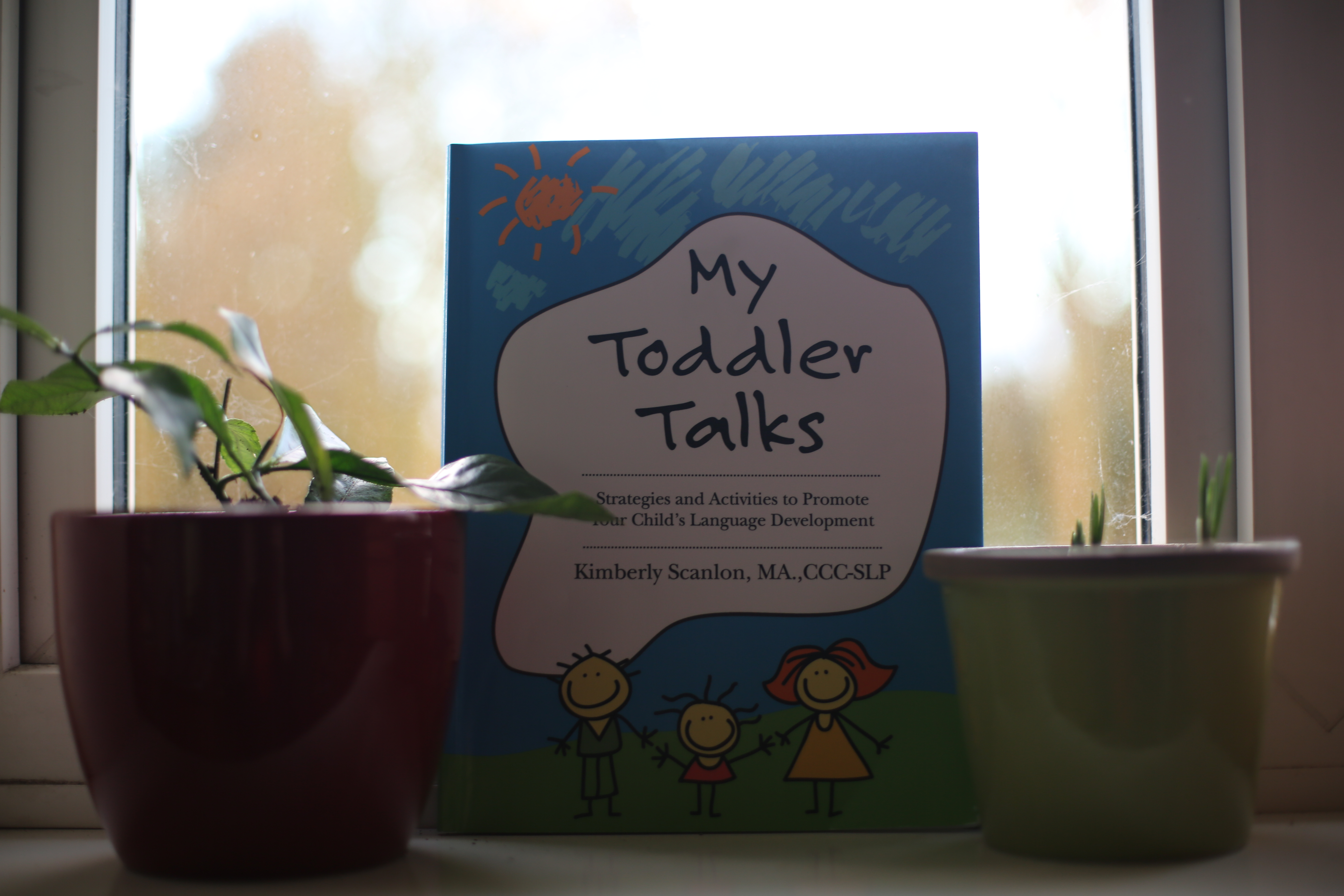
If you are a parent and you’re interested in your child’s language development, you might have heard of Kimberly Scanlon. She is a speech therapist who throughout her work developed a strong expertise in building up children’s communication skills.
In the book that I am recommending she offers 25 play routines (with toys and arts and crafts) in which she describes the activity and suggests appropriate strategies that the parents can use to elicit responses and expand vocabulary. She also offers tips on What to Do if the Toddler Is Not Imitating You and The Do Not List. I also found the Introduction and How to Use This Book sections extremely valuable as they were both informative and reassuring.
Our son is being brought up with three languages and I am his primary source of Polish language, my husband is his primary source of Italian, and English is the language of the community. At the moment all three languages develop at the same pace but slower than the language development in his monolingual peers. Thus, by monolingual standards, he experiences a language delay. I’ve been looking for a book that would improve my ability to stimulate my child’s language development, but also for a text that I could recommend to my child’s nursery. Although this book is not about how to talk to multilingual children, I like its focus on simplicity, language-wise and play-wise. I like its very practical and realistic tone too. It definitely sets the expectations right and makes you question less and communicate better. Scanlon, K. (2012) My Toddler Talks: Strategies and Activities to Promote Your Child’s Language Development. Createspace, North Charleston, SC.
This is not a sponsored post. Just a recommendation.
Bringing up a toddler means many things, but when it comes to good playtime it primarily means embracing movement. Toddlers love to move, they have the energy and need for action. Frequent runs around the park and playground are one way of exhausting their energy (and they are certainly effective) but it’s helpful to bring variety to our routines and have a set of activities for our toddlers to do at home and outside.
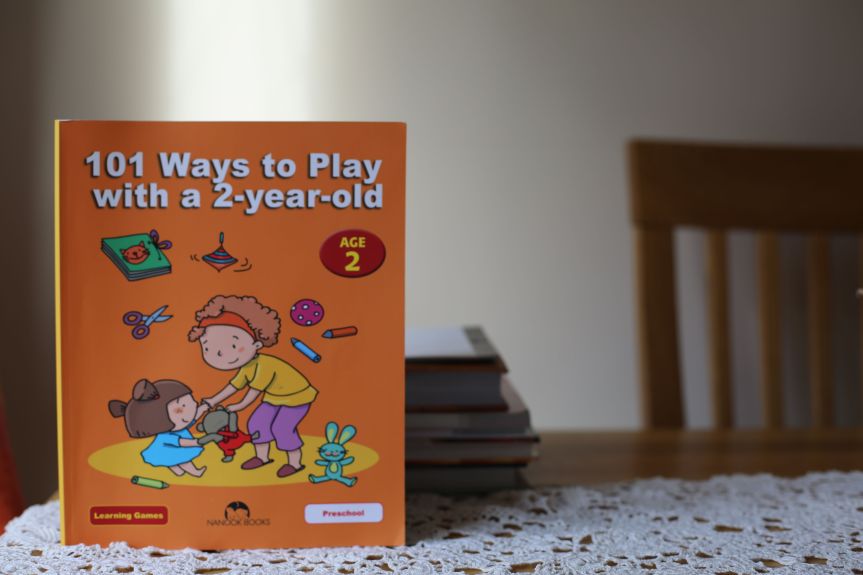
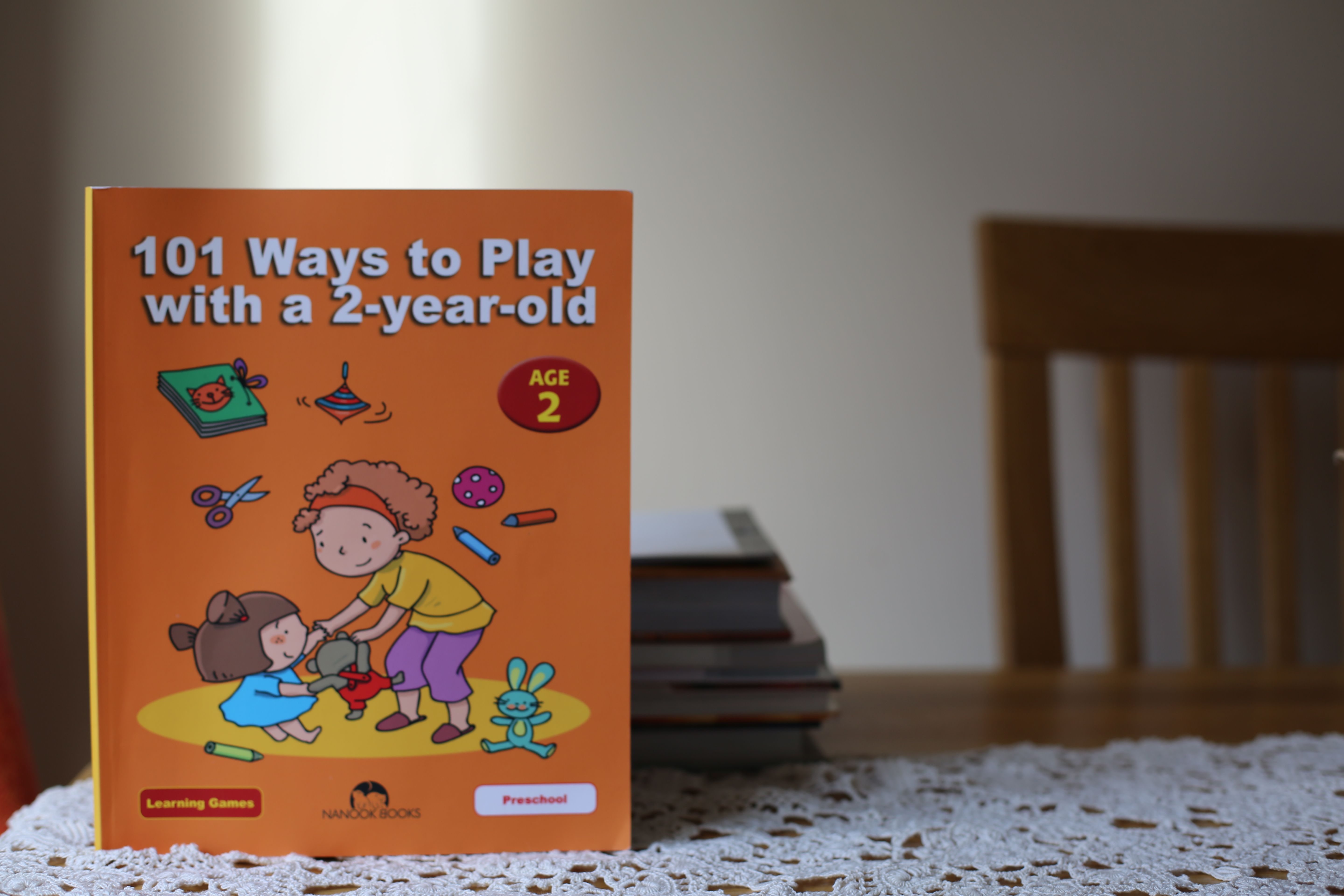
I was looking for a book that would give me ideas on how to play with my two-year-old and would help me with activities for a group of small children. My son is our first child and sometimes we haven’t been very successful at choosing games and entertainments that he would have enjoyed. Once I felt really out of depth while running a community event for toddlers in my neighbourhood. It’s not as easy to get them organised and interested as some may think.
When I found 101 Ways to Play With a 2-year-old I was really really happy and astonished at how easy play with toddlers can and should be. The book offers what it promises in its title (101 activities). Each activity is presented on a separate page and is beautifully illustrated with a drawing that make you immediately imagine yourself and the toddler at play. They are also marked with a difficulty level so you may want to start with the very easy ones and try other ones later as you child progresses towards being a three-year-old. But in all honesty, I wish I had this book even before my toddler was two as really some of these games are fabulous to try even before they pass their second birthday.
Another very strong side of the book is that it doesn’t demand any additional toy purchases or having fancy things around. Everything that is used in the book for good playtime you probably have already at home (a piece of string, shoes, crayons) or you will be able to find in your local park (stones, leaves). I read the book when I have a free minute here and there and I look for opportunities to use the ideas as our week unfolds. It’s all really nice and simple. This morning, for example, while waiting for our eggs to boil, we were making different shapes and patterns out of a piece of string, naming them and having fun together. An easy and lovely distraction prior to the meal.
Title: Angevin, D.; Jackle, A., Langowski, M., Lucky, B., and Torrent, B. (2014) 101 Ways to Play with a 2-year-old. New York: Nanook Books.
This is not a sponsored post. I am just sharing experiences and information.









 Postcards Without Stamps