Success and community

IMG_1915pm

“It takes twenty years to be an overnight success.” Eddie Cantor, performer

I keep on reminding myself of this quote every time I start a new project. It’s never easy to create something valuable and lasting. It’s never easy to create something that will be well-received, stretching and useful at the same time. Last week I started a new project in our community aimed at Polish children. I wanted the children and parents to meet, sing, read poems and do some craft together. Sounds simple, but it’s not. Children are more unpredictable than I thought and my own child is too. I was able to foresee that he might not want to participate in some activities and that he will try to taste most things, but what I didn’t predict was that he will be regularly running out of the room to press the exit button for wheelchair users to open the main door of the centre. So, as you can imagine, this combined with the efforts to advertise, plan and execute the event didn’t make the job very easy.

Nonetheless, I have made a commitment to create something for the local community and so I will press on (just like my toddler with the door button).

I have chosen a community centre in my neighbourhood rather than a Polish church or a Polish club for the event because I do like when communities venture beyond their comfort zones and when they engage with different places. I think it’s very important not to confine ourselves. It’s liberating. I also believe that once the small children will feel comfortable with coming to the centre to do the Polish activities, they will become happier at attending other activities too (those that are aimed at all children).

What’s more, I have chosen my area because there is nothing more heart-warming than living in a socially accessible neighbourhood. It makes a big difference to our daily sense of contentment. It makes us perceive the world in brighter colours too and reduces anxieties about the people who live a street away from us. Someone told me the other day that they don’t like walking down their street because they don’t know the people who occupy the houses there. Is this fear not something that we should try to counter? Don’t you think that it’s true that we perceive streets to be nicer and friendlier if we know at least one person who lives on those streets? Neighbourhood activities make sense, don’t they? Even if the only thing that they do is to reduce our fear of walking to the bus stop.

Anyhow, I hope I will rise to the challenge of entertaining toddlers and that it will take me less than twenty years…

Any ideas of how I can do it?
IMG_5044

Neighbourhood – an anonymous group of strangers?

A while ago I really started to suffer from being anonymous. I’ve been living in the area where I live now for a few years and the fact that I don’t know even the names of people who live on my street has started really getting me down. When you give birth to a child, you realise the importance of a community, anonymity is depressing – you want to know people and you want the people to know your child so that they can also keep an eye on his safety. But equally you want to look after other children too, as if the sheer fact of you becoming a parent made you a parent to other children too.

Are you not tired of not knowing your neighbours? Are you not tired of being impersonal? Are you not tired of shallow and occasional nods and greetings? I am. It’s certainly not the way I want to live my life. It’s certainly not how I want to bring my child up – within an anonymous group of strangers

Often.. I feel that we’re failing as social human beings. Look at our homes – they are like hotel rooms perched in the same corridor and we just see the other residents when they lock or unlock their doors or sweep their front doormat (that ironically often have ‘Welcome!’ written on it). We cannot treat our neighbours as if we or they were here only for a night. We live here – 52 weeks a year! In this borough, in this street, next to each other! We must do something to get to know each other better. To engage in a community at our doorstep.

I believe that one of the reasons why so many people complain about multicultural society is precisely because we do not spend time with our neighbours. We do not have or make occasions to meet them. What do we do, for example, to find out information? We search the Internet… What if we run out of milk, salt or sugar? We drive to that 24 hour supermarket. In the past it would be neighbours, friends or family at whose doors we would knock without hesitation… We would visit them or call them, they would instruct us, teach us, help us… Now these are the faceless, impersonal tools that we choose or are compelled to choose. Another lost or reduced opportunity in making a human connection with those who are in our proximity, with those who live nearby.

And our children? Why do we keep them indoors? Why do we place them in front of screens all the time? It really doesn’t take that much time to visit the nearest playground. Even 15 minutes a day on a slide can make a new friend to your son or daughter. Take your children out, venture to your local children or community centres, go to the local park, use the playground. They are there for us to be used. They are there for us to visit.

It’s possible to create a community. We just need to meet and talk. We need to create opportunities for conversation and for spending time together. It’s the only condition. There is a limit to the extent to which we can develop on our own… we need groups of people to overcome our limitations, we need each other to realise those limitations, to become truly human we need each other. Call me idealistic, but I really would like to change my neighbourhood and improve myself with it.

In the middle of the week friends visited our house, we ate together, our children played together, we laughed and talked. Usually the middle of the week can feel quite heavy and daunting, that evening was uplifting, it made us feel loved and connected. It made us belong.

I like to get that feeling from walking down my street… that pleasant feeling of belonging and being part of something bigger than myself. Wouldn’t you?

October too, belive it or not

Postcards

GUEST POST: The Fight Against The Decline Of Book Reading

Tara Vickers Photo
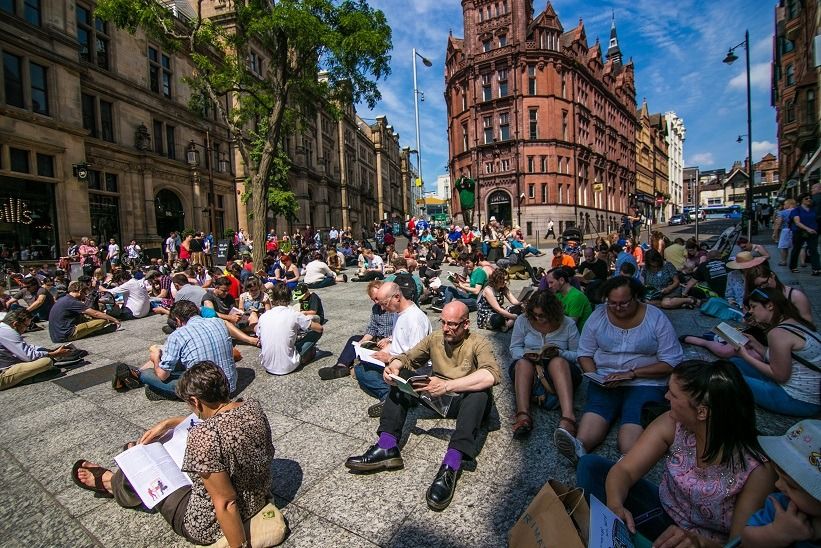
A reading flashmob in Nottingham, July 2014. Photo: Tara Vickers, 2014

I have the great pleasure introducing today’s guest writer James Walker. He is a literary journalist and the editor of the literary graphic novel Dawn of the Unread. Here he writes about the fight against the decline of book reading.

The Fight Against The Decline Of Book Reading by James Walker

On the 12 July 2014 I and a few friends decided to organise a reading flashmob in Old Market Square, Nottingham. 400 odd people turned up armed with books and we joined together in a very silent protest. Our aim was to make reading a visible act, and to show our appreciation to the writers, publishers and bookshops who have brought us joy over the years.

Physical books are slowly starting to disappear from the high streets and it’s not just because of the Kindle. In February, independent bookshops dropped to below 1,000 for the first time. This is largely due to high rents as well as a drop in demand. Bookshops pay the same rates as other businesses yet it is simplistic to categorise them as ‘retail’. Firstly, they are never going to be as profitable as say a clothes shop and secondly, they have an educational function. If councils don’t change their attitude our town centres are going to be nothing but Poundstretchers, Tescos and American coffee shops.

Libraries, when they’re not being closed down altogether, are seeing opening times and staffing numbers reduced due to cuts. The old argument that other services (such as hospitals) are more important is simplistic and divisive. The UK was recently positioned 22 out of 24 industrialised nations for illiteracy. This is particularly worrying given that there is proven evidence that those who don’t read are less likely to vote, become home owners and lack general confidence. Cuts also mean that less books are stocked which in turn impacts on the livelihood of writers who are already pretty much at the bottom of the food chain.

These are just some of the issues that motivated the people in the picture to sit down alone together with their favourite books. Reading is also something that is able to unite every type of person, cutting across cultures, gender, ethnicity and age. Yet despite its ability to unite all communities and its role in developing us intellectually and emotionally, it is something which local government seems to treat with contempt. Now we’ve all sat down together quietly, perhaps it’s time we all started to shout for what we believe in…

James Walker is the editor of literary graphic novel Dawn of the Unread. The flashmob was organised as part of their campaign to raise the importance of reading. Their next public event is a game of zombie mastermind as part of the Nottingham Festival of Words (19 October, 3pm, Old Market Square, Nottingham) which will see four dead writers come back to answer questions about their literary lives www.dawnoftheunread.com

Nothing New and Happiness

sunflowers

The Nothing New project made me think a lot about the relationship between happiness and possessions. There was a moment in that project when I thought to myself: should I start hating all material possessions now, despise the material world, should I reject my belongings altogether? Then I examined it deeper and I decided that if I did that, it would be irrational and totally against what I felt too. Because I haven’t been buying anything new, I have regularly engaged with what I own and this regular encounter with my belongings brought about my strong appreciation of what we have. The other day I was sorting through my son’s toys and books and I noticed that we actually play with everything that he’s got and we’ve been reading most of the books. His and my clothes are also well-worn now. A large number of clothes that my son has are hand-me-downs from my sister’s friend. We received a big bag of those in exchange for my photographic skills. Every time when I dress my son in one of those items I think of that lovely family and the kids that I’ve photographed. I feel very connected to them.

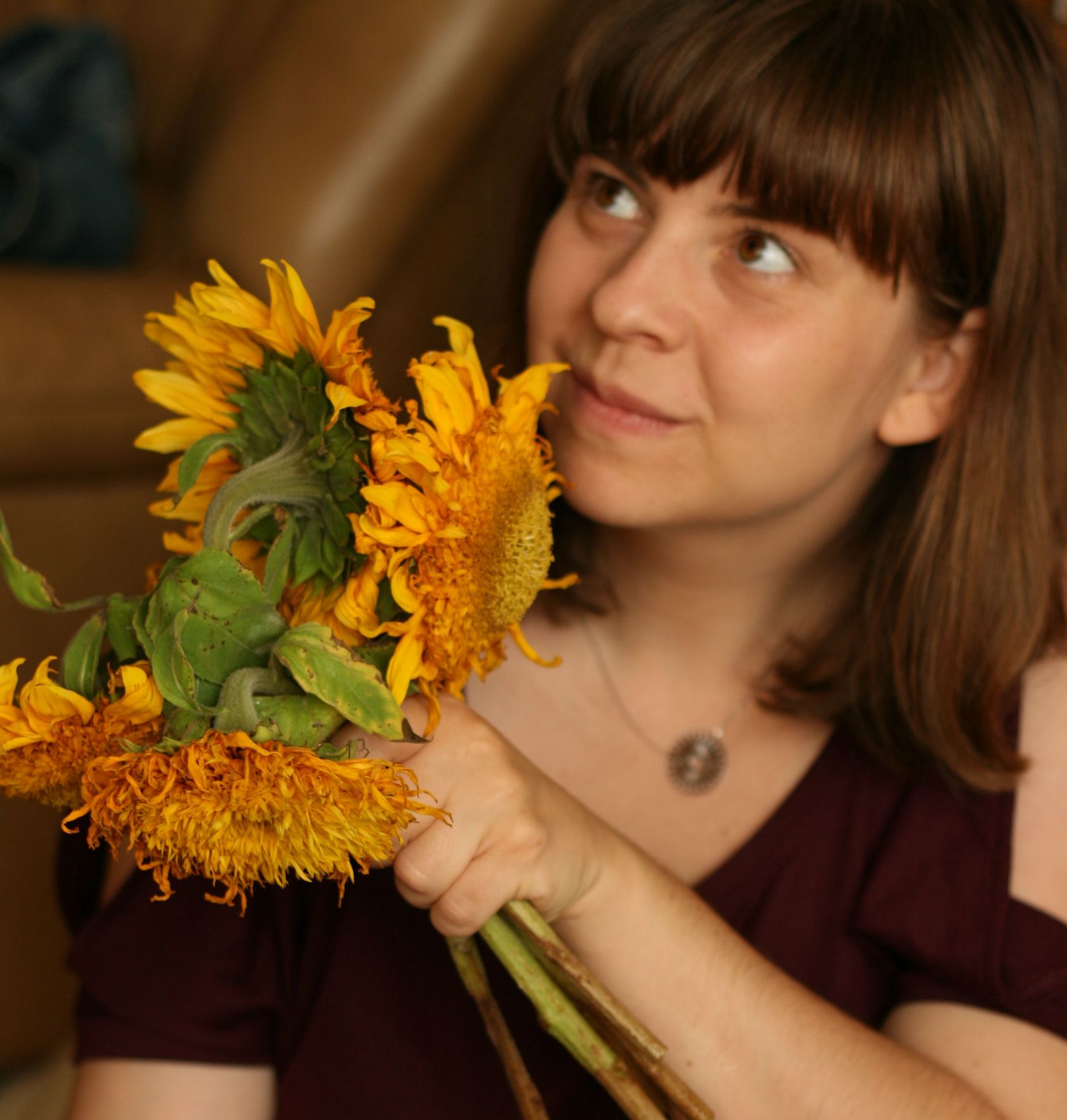
Similar feelings appear when I use or look at other things, little tokens of familial love and friendship: 12 colouring pencils that lie on my desk remind me of a very kind Italian girl that I’ve just recently befriended and who gave me those pencils after I explored with her different ways of becoming more organised; a Happy Easter 2014 cup with dotted eggs carefully painted on it make me think every day of my husband’s lovely little nephew and a necklace that I’ve been wearing almost every day draws my thoughts to my godfather who just by being himself has for years been an amazing sMe, wearing the present from my godfatherource of strength and inspiration for me. These and other well-used items represent and remind me of people who are part of my life, even though I do not see them often. The difference between these objects and those that are still waiting for us in shops is that they have been filled with people’s faces and emotions. They have come with a cordial soul that those items at shops simply do not possess yet.

The Nothing New Project was initiated by Inked in Colour. Pop over to the blog. There is plenty to see there and I am sure that you will be inspired too.

Nothing New: moving forward

mountain_flowers

My Nothing New Project has come to a standstill over the summer. I came across a few situations where I didn’t have a choice but to buy something new for myself and my son. Things like that always happen when you think you can relax, don’t they? For example, when you simply forget to pack that essential jacket you need because the place where you’re staying in the mountains drops to 6°C or when your child’s feet grow almost overnight and you realise that he will not make many steps in the old ones any more. I’m forgiving myself these small departures from the nothing new project as they really are justifiable but there is something else too… my little weakness that I indulged in while in Poland. I love Polish children’s’ songs and stories (written and spoken). I tried to say no to them, but I do see them as an essential part of my son’s childhood. And not just my son’s. They will also be used by a number of children because I am starting a group for Polish kids in my town which will focus on popularising Polish rhymes and stories among the expat children. So it turns out that those books have become a bit of an investment into community building and I’m happy I am making use of this investment.

So all in all, what’s the status of my nothing new project? I’ve slipped but I am carrying on, being mindful of what and where I buy or what I don’t buy. It’s almost the end of September and pre-Christmas shopping madness is about to start – I am sticking to the nothing new project just for the sole purpose of staying true to the message of the Christmas period – that new is born and not bought… that a true and long-lasting regeneration and renovation comes from effort, time and nourishment. So for these next few months I’ll carry on learning how to be patient, more hard-working and nurturing. I hope you’ll stay with me to see to it. ;)