

Developing Good Communication Habits with Toddlers: Book Recommendation

My toddler talks_book recommendation

If you are a parent and you’re interested in your child’s language development, you might have heard of Kimberly Scanlon. She is a speech therapist who throughout her work developed a strong expertise in building up children’s communication skills.

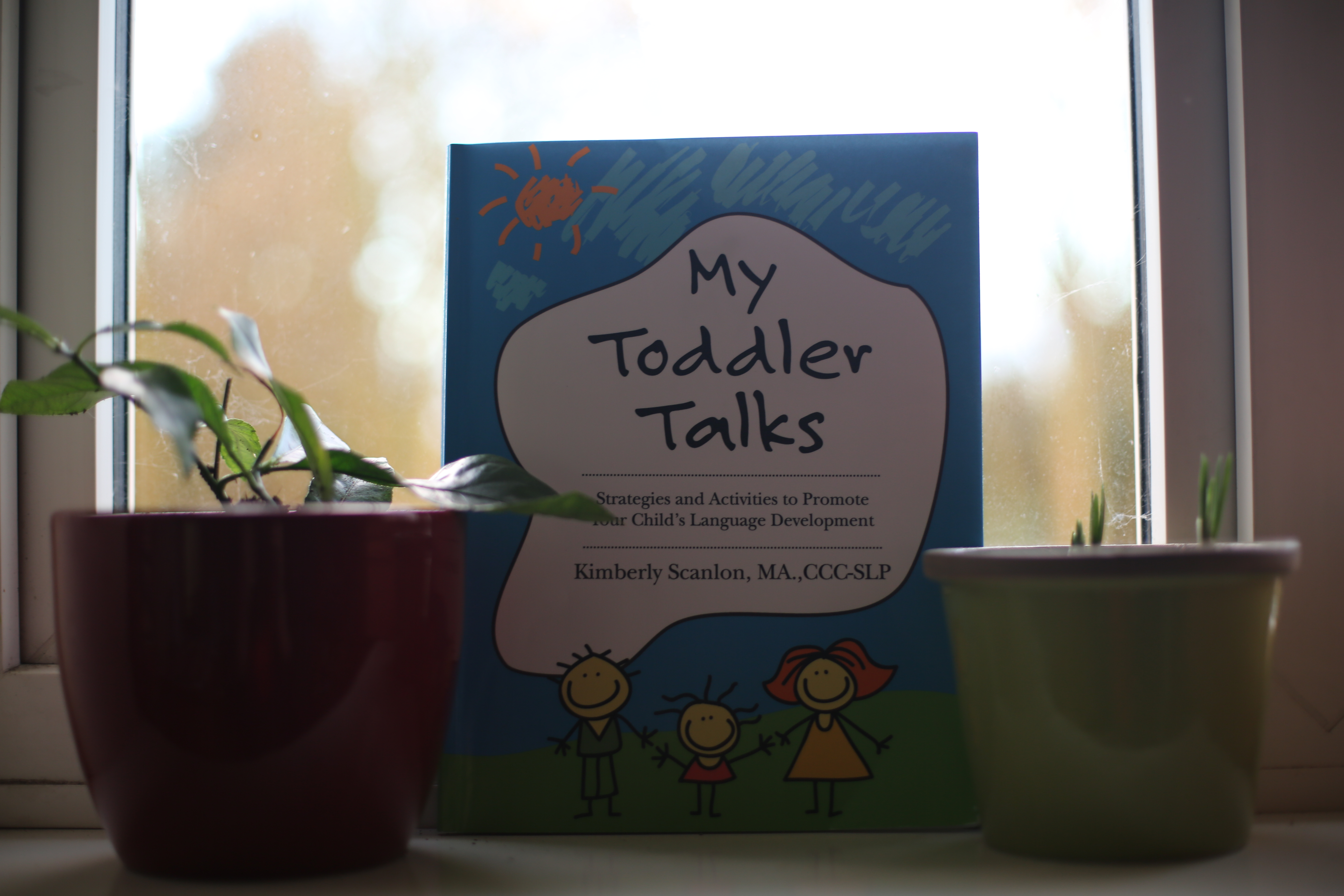
In the book that I am recommending she offers 25 play routines (with toys and arts and crafts) in which she describes the activity and suggests appropriate strategies that the parents can use to elicit responses and expand vocabulary. She also offers tips on What to Do if the Toddler Is Not Imitating You and The Do Not List. I also found the Introduction and How to Use This Book sections extremely valuable as they were both informative and reassuring.

Our son is being brought up with three languages and I am his primary source of Polish language, my husband is his primary source of Italian, and English is the language of the community. At the moment all three languages develop at the same pace but slower than the language development in his monolingual peers. Thus, by monolingual standards, he experiences a language delay. I’ve been looking for a book that would improve my ability to stimulate my child’s language development, but also for a text that I could recommend to my child’s nursery. Although this book is not about how to talk to multilingual children, I like its focus on simplicity, language-wise and play-wise. I like its very practical and realistic tone too. It definitely sets the expectations right and makes you question less and communicate better.
Scanlon, K. (2012) My Toddler Talks: Strategies and Activities to Promote Your Child’s Language Development. Createspace, North Charleston, SC.

train_playtime

This is not a sponsored post. Just a recommendation.
Bringing up a trilingual child – the beginning

Three languages

Those of you who are familiar with my family setting would know that we use three languages at home. I had the great pleasure to write about bringing up a trilingual child for www.trilingualchildren.com It’s a wonderful space full of great advice and wonderful stories. Below are the leading paragraphs to my article:

More delight, less doubt. Bringing up a trilingual child – the beginning

I just came back from the hospital with my small and beautiful little boy. He was an easy-going newborn who settled himself into a nice routine very quickly. I loved holding him in my arms late at night and absorbing his peace. Blissful, wonderful peace. I felt enormously happy. I felt rewarded, blessed and enriched; but my fortune was not made of money, but of affection and attachment that strengthened and deepened with every day, unconditionally, unremittingly, and peacefully.

It was in this peace of a quietly breathing newborn baby, in a room that smelled of baby shampoo, just after midnight, that I realised that I want to bring up my son as a trilingual child, that the biggest gift my husband and I can give to him is the gift of languages, an opportunity to enter and explore his parents and grandparents’ cultures and to draw strength from them.

But there are other reasons too. That night when I was looking at my son, I saw generations of people in our genealogical lines that came before us. My son wasn’t made of me or my husband only… those genes that made him where not ours only. I understood then that my son has already got a heritage, a heritage that he won’t be able to understand or access without knowing and understanding the languages that my husband and I speak. Raising him up with one language seemed unfair… both towards him and those people before us.

So there we are, living in multicultural Britain, bringing up a toddler speaking Italian, Polish and English and doing everyday things just as other families do. We are developing our routines and with those routines our toddler is grasping the languages and learns about the world. Many parents tend to get overwhelmed at this stage of their child’s development because it’s so easy to think that you need to provide additional language input on top of the usual care. To me it’s about using language while exercising daily care, while bathing, while potty training, while putting the shoes on and when collecting toys off the floor. The language comes with care and attention. It’s not separate from it.  Click here to continue reading…