
At the Hindu Temple Geeta Bhawan n Derby
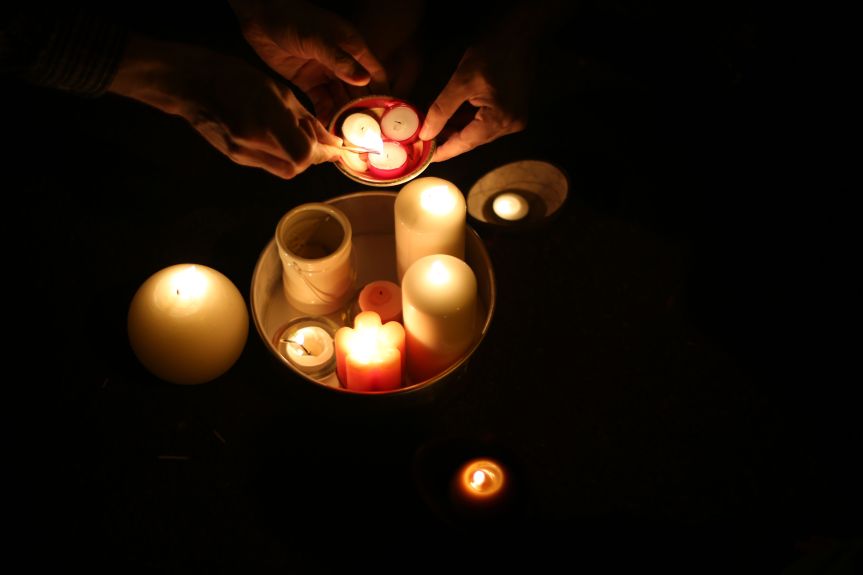
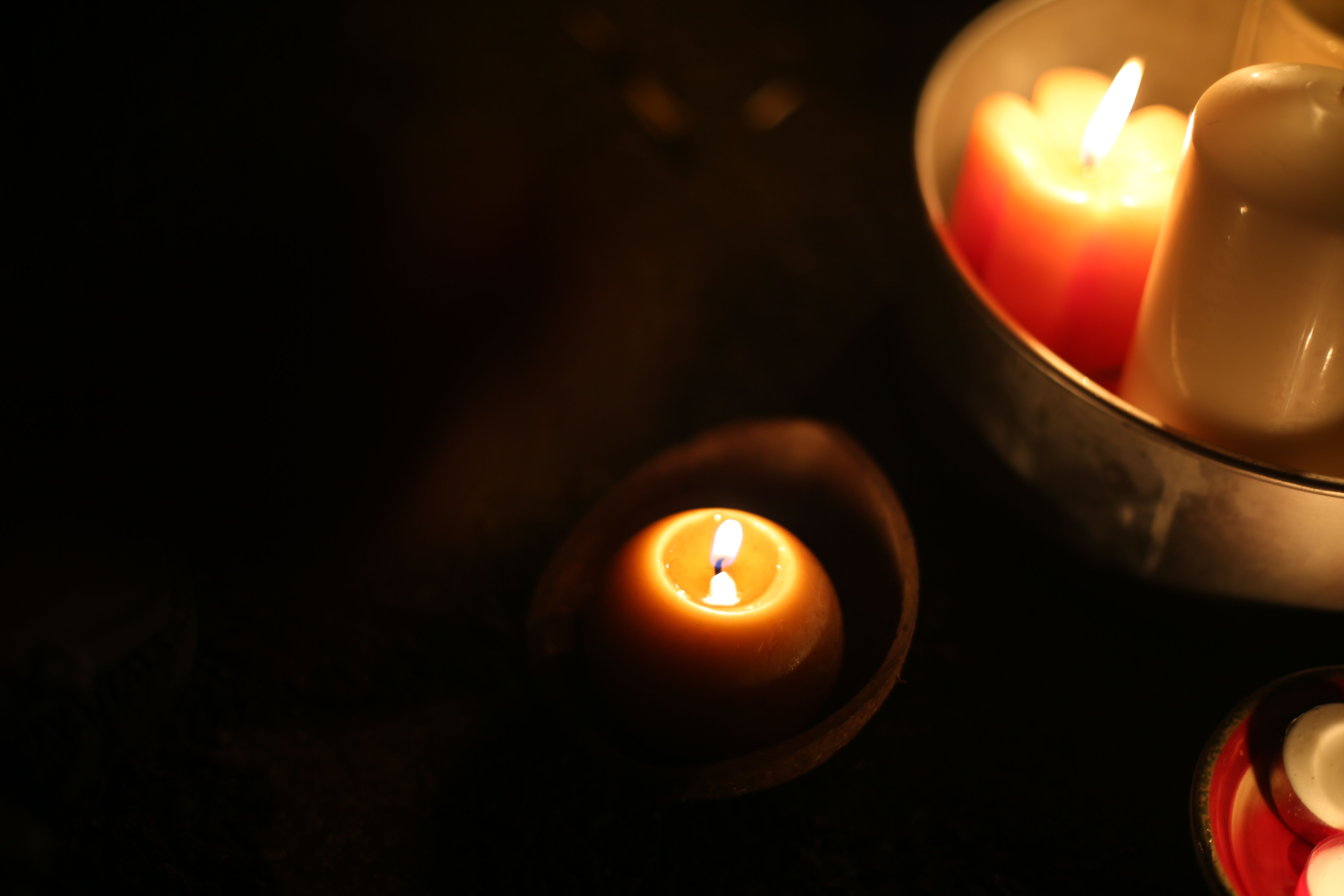
On the 31st of October, we celebrated in Derby the festival of light, Diwali alongside other festivities and the hype of Halloween. It can seem a bit strange that I am writing about this on Thanksgiving Day but on the other hand I feel it is most appropriate because in fact we rarely give thanks to each other for permissions to see and participate in the lives of our diverse communities. When we start to socialise into the routines of communities other than our own, we spot differences but at the same the common needs and burdens as well as the efforts to make us feel welcomed and included. This is a lot to be thankful for.
When years ago I started a doctorate (and never completed) at MOSAIC at the University of Birmingham in Multilingulism with the use of autoethnography as a research method, I was learning how to write about oneself as placed in a multicultural British landscape and in an eclectic family. The task was confusing and insurmountable at times and for a long time I could not pin down where the difficulties were coming from. Until of course I understood… One was coming from a commonly held belief that talking about oneself is not the done thing, let alone to research oneself in the context of multiple cultures… this seems even more odd. Anyhow, my doctorate collapsed during the Covid-19 pandemic under the pressure of ill health, two small home-educated kids, my husband’s increased workload (no, he was not on furlough) and my need for creative rest that I am still very much a supporter of. That said, although my doctorate collapsed, the need to engage in local communities remains strong.
On the surface looking into the culture of a different community seems like having nothing in common with doing research into oneself, except when the holy scripture of that group teaches you a lot about self-intelligence and its importance for life well lived. The Gita actually uses the term ‘self-intelligence’ in its writing legitimizing self-knowledge, discipline and broader awareness of values that govern us and our choices. Indeed, who would we become without our ability to self-reflect and observe.
In the book Natural Law & Natural Rights, John Finnis lists 7 basic goods of human life necessary for our well-being. Among them, he lists: 1) life (itself with health, safety and self-preservation), 2) knowledge, 3) play, 4) aesthetic experience, 5) sociability (friendship), 6) practical reasonableness and 7) religion which of course concerns itself with love, the importance of truth, goodness, transcendence and the boundaries of human freedom. These common goods order and create what we call ‘quality of life’ and determine our overall satisfaction of life. Thus, part of learning about each other and our cultures is to see how we go about those values and common goods in our cultural groups and settings.
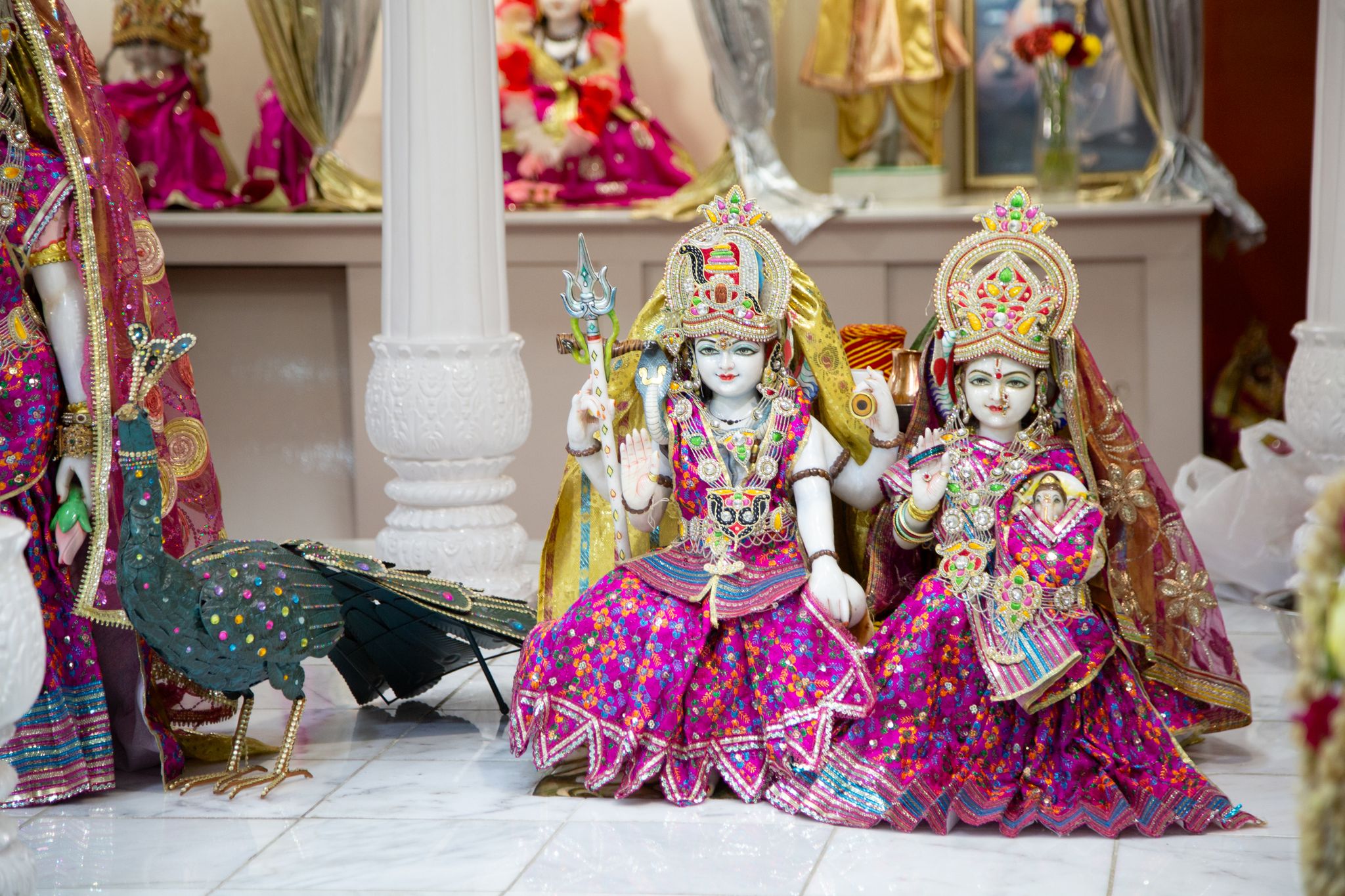
So here are a few postcards from Diwali as observed in Geeta Bhawan in Derby. For this post, I asked two mums to whom I chatted about the Gita, Radhe and Sarbjit, to explain to me who and what I saw at the Temple. They replied on WhatsApp.
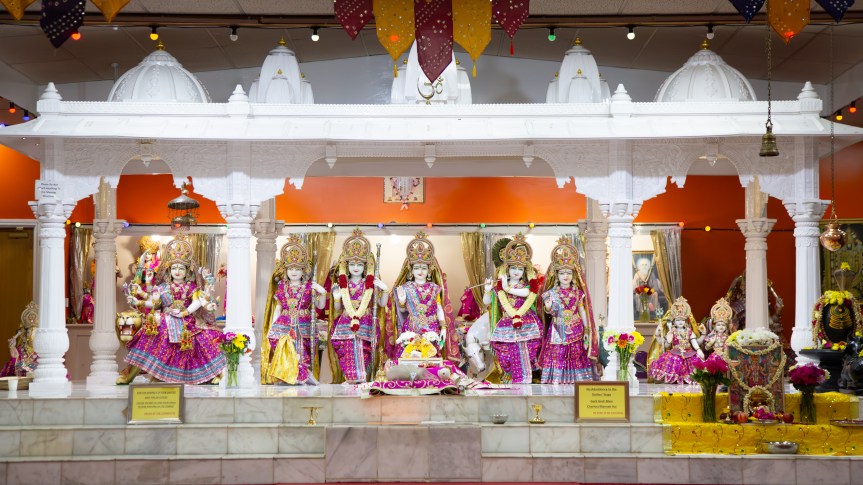
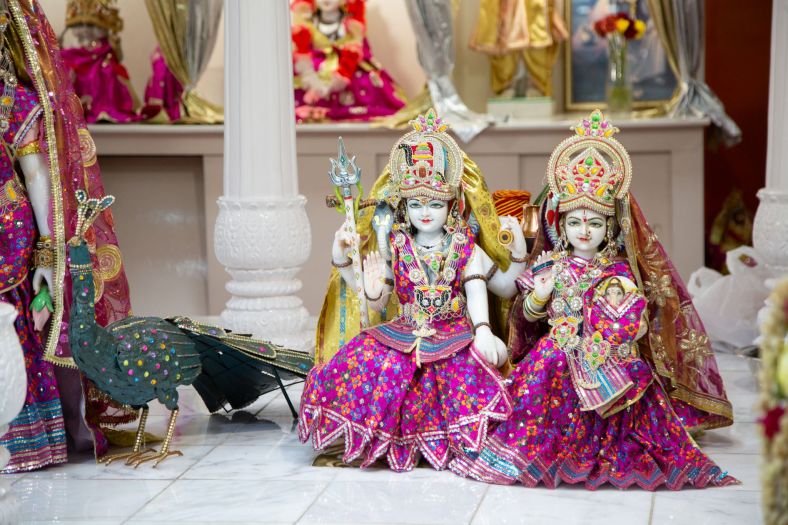
Who are the gods/ deities here?
Radhe answered: ‘Shiva (with Trident) Parvati Devi (also known as Durga). In her arms Ganesha.
That peacock is standing besides Radha and Krishna’

“Abode of Krishna is called VrindaVan (Forest of Tulsi plants – one type of basil)
So eternally Krishna lives in a forest..residents of VrindaVan possess pure love for Krishna.
So in eternal vrindavan Krishna z devotees are in the eternally in the form of trees, parrots, peacocks, cows, cowherd boys, cowherd girls. Their forms are based on how they want to love Krishna…that will be a long discussion
Anyways, the story goes once Krishna was playing on his flute and has invited the animals of VrindaVan for a dance. Peacocks were dancing very gracefully. Soon Krishna joined their dance, looking at Krishna dancing peacocks started marveling his dancing.
Then the peacocks offered their best possession to Krishna, peacock feather. Krishna accepted their offering and honored it by always wearing peacock feather on his head.
In the middle, if I see correctly is Gopal – baby form of Krishna. Krishna reciprocates to the desires of his devotees. Many devotees want to love him as their own child so they worship him as Baby Gopal.
We worship deities by offering them clothes, food, jewellery.
So the deities are dressed in different colours the day you visited the dress happened to be of purple colour. Their is no particular significance of purple colour.
Next time if you ever choose to go you may see them in a different colour.
Traditionally on full moon day deities are offered a white dress.
On ekadashi (one day from the lunar calendar) offered a red dress.
By offering service to deity form of the Lord one can get purified of sinful desires. Sometimes people offer such service as an expression of gratitude.”

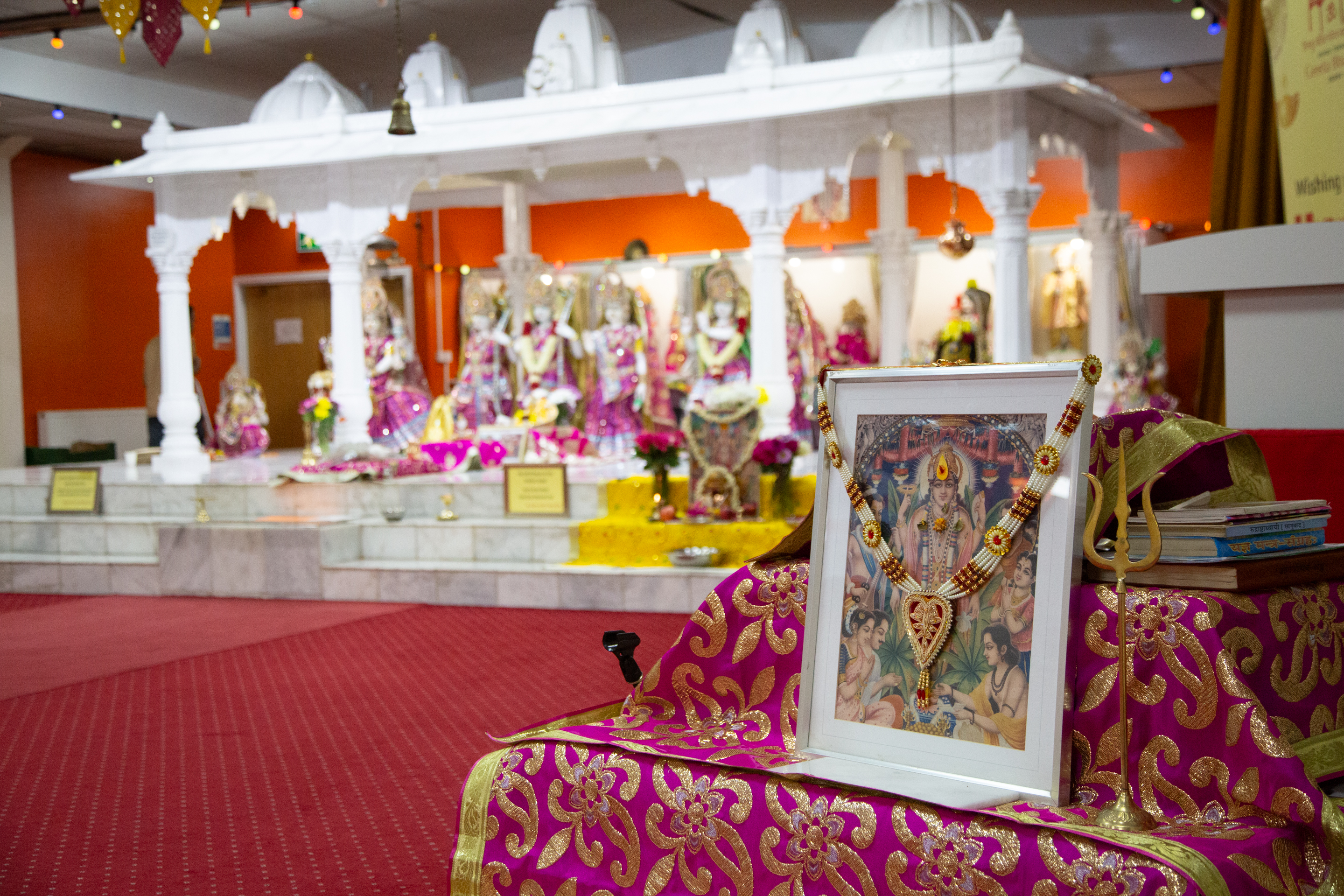
“Food has an significant impact on our consciousness. In Bhagvad Gita you may have studied about Sattvik, Rajasik, Tamasik.
We offer Sattvik food to the Krishna. When he accepts that offering it becomes Prasadam (which means Grace/mercy)
Prasadam will purify our consciousness.
That fruit was Prasadam. (…)
You visited the Temple on Diwali day, on Diwali people worship Lakshmi Devi and ask for prosperity.
[In the framed photo] is Lakshmi Devi, goddess of wealth.”

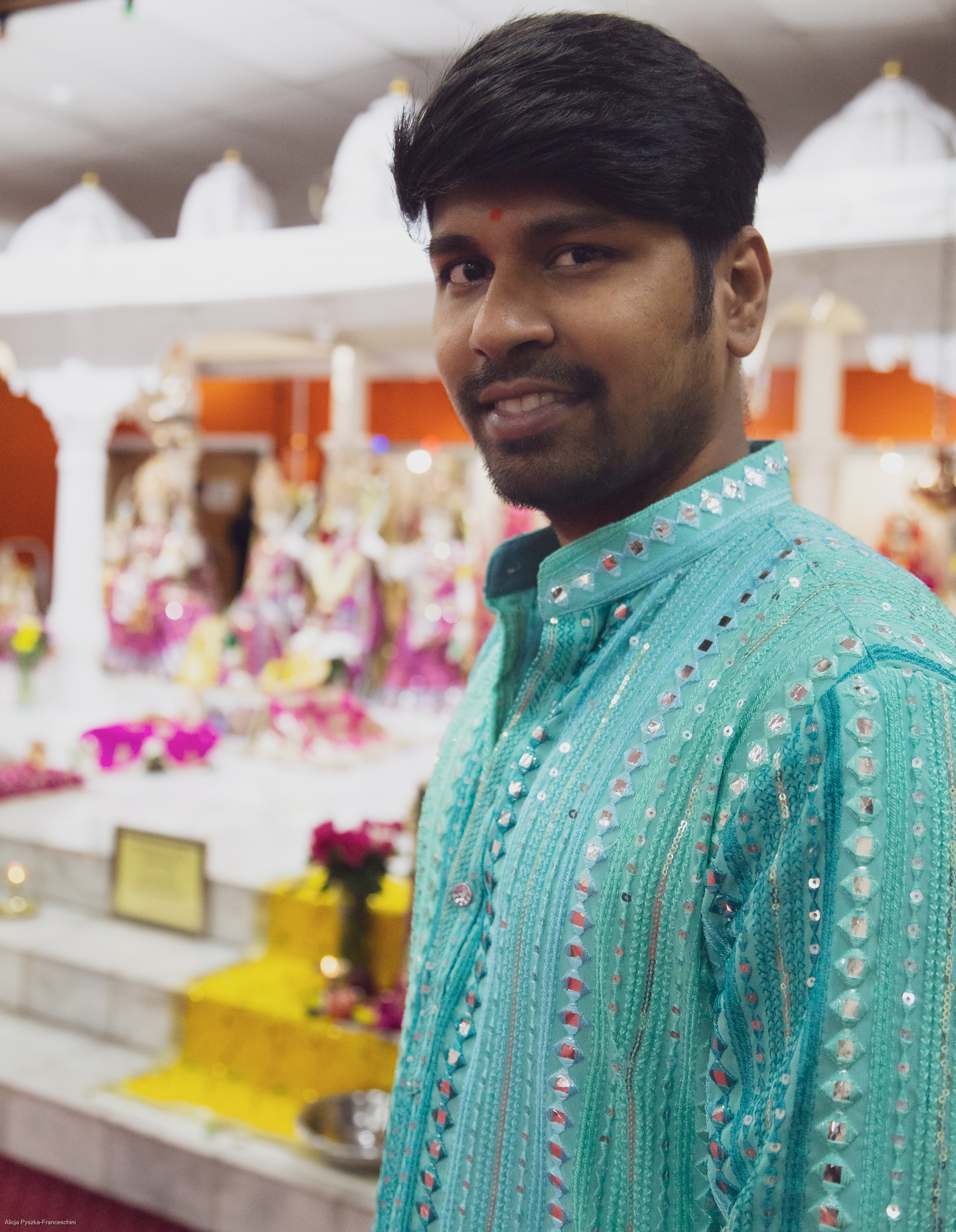
I also asked Sarbjit who visits the temple to tell me about a senior person who was distributing fruit towards the end of the prayer as I did not know who he was. Sarbjit replied, “If that man was wearing different clothes, then it was a Pandit. Otherwise, he could be a sevadar (volunteer).” During the worship people walk around the alter and worship each god separately after that they receive a piece of fruit, just before they leave the temple. The man very humbly told me that he is not a scholar in the study of religion and that there was someone else there who could have done it if I was there a lot earlier. But what he said, was that the most important thing is to remember that the gods/ the deities are indestructible and that what we as human beings cannot correct, they will do it for us. They will correct all the wrongs. This message I found to be most comforting. I hope you do too.
Happy Thanksgiving. May the light of Diwali keep on shining on us.
Thank you to Nikhila and Karthik for agreeing to be featured in the photographs for this blog post. Additional gratitude goes to Radhe and Sarbjit who supported me with their understanding of the customs here. Thank you very much.
Any comments and corrections more than welcome. :) Thank you all.
The text I referred to in the article is:
Finnis, J. (2011) Natural Law and Natural Rights. Oxford University Press: Oxford.







 Postcards Without Stamps