One of the things that I do with my daughter is painting. She is 6 at the moment and loves creative expression. To talk about colours, mixing and cleaning brushes covered with oil paints, we sat down at our dining table, lied down a huge white canvas and painted together with old dry and new brushes, wooden blocks and all available fingers and tools at hand. After the session at the table, we hang the painting, took a photo and edited the screenshot in a photo app on my phone using available filters and tools erasing parts of the photo, smudging it or camouflaging some elements of the photo. Talking while creating is very natural to us so we were able to create a nice conversational flow focused on filling up the empty canvas. Try this too and show us your creations. 🙂
Jedną z rzeczy, które robię z moją córką, jest malowanie. W tej chwili ma 6 lat i uwielbia twórczą ekspresję. Aby porozmawiać o kolorze, mieszaniu, czyszczeniu pędzli z farby olejnej w zeszły piątek usiadłyśmy przy stole w jadalni, rozłożyłyśmy ogromne białe płótno i pomalowałyśmy je razem używająć starych i nowych pędzli, drewnianymi klockó i wszystkimi narzędziami, które miełyśmy pod ręką. Po sesji przy stole powiesiłyśmy obraz, zrobiłyśmy zdjęcie i edytowałyśmy zrzut ekranu w aplikacji fotograficznej w telefonie za pomocą dostępnych filtrów i narzędzi wymazujących części zdjęcia, rozmazujących je lub kamuflujących różne elementy zdjęcia. Rozmowa podczas tworzenia jest dla nas bardzo naturalna, więc udało nam się stworzyć przyjemny przepływ konwersacyjny skoncentrowany na wypełnieniu pustego płótna. Gorąco polecam wszystkim.
Zachęcam do eksperymentów i pokażcie nam swoje prace!
Pozdrawiamy,
Alicja Pyszka-Franceschini i córka Gabi
First published by my on my other site: Accomplished Squirrel dedicated to multilingual communication.
Photo: ‘Tissue’ by Alicja Pyszka-Franceschini, 2024.
There is a famous painting by Andrea Mantegna called by many as The Dead Christ (see here). It is a striking picture. It shows Christ’s body laid down on a bed after the crucifixion. The painting uses foreshortened perspective as a compositional technique.
Christ’s body appears shorter than it really was. It is squashed almost to an unnatural size. Both of his palms are curved and fingers bent like claws. His pain is noticeable although He does not feel pain any more. The foreshortening of perspective is aching to foreshortened life, of course. I have no doubt about that. However, there is an aura to the painting of something forgotten too. Of someone lacking foresight or full sight. The painter did not have it. Neither do we as spectators. From Christ’s body posture, though, we infer that he was as much in psychological pain as he was physically suffering. Would his posture be different if he took less blame? Was Jesus tormented to mercy*? How did He experience this torment? And why on Earth did He do it?
On one level or another Jesus knew that making his soul of steel, would be ill-advised.
Making our souls of steel
is ill-advised.
Jesus, it seems to me, was after nonconstructive criticism. He focused on stupidity, biased and prejudiced thinking. He sought out the injustices done to him and others through others.
As we seek those done to us
and by ourselves less so
But why has Jesus gone through the hurt-optimization procedure? I can guess that it would be to build up his capacity for something. Could it have been forgiveness?
It sounds insane, doesn’t it?
*I read the phrase ‘a torment of mercy’ in one of the books by Adam Philips, I think it was On Getting Better. I apologize to the author for a lack of appropriate reference.
The post is a short version of a draft of an essay in progress by Alicja Pyszka-Franceschini, 2024-2025. All rights reserved. Copying without an written approval of the author prohibited.
Our car of 15 years showed three flashing lights on the dashboard while we travelled to Whitby last Sunday. It displayed them during Summer too when we were driving to Poland from the UK. We got it repaired but the same problem showed. ‘We’ll give it a rest when we get to Whitby. It will cool down and we’ll be able to drive back.’ my husband said. His prediction was right. We returned home safely. One thing to be rather grateful for today.
We travelled to Whitby for air. To feel the sand between our fingers and water on our feet. And to eat fish, of course, an irreplaceable custom of every food lover. We headed towards the beach when we saw a crowd of people returning towards the car park. We seemed to be the only family that walked in the opposite direction. ‘Was everything fine?’ I wondered examining the opened restaurants, stalls, coffee shops and calmly floating boats and yachts. The surrounding was reassuring and the lobsters and crabs painted on restaurant walls seemed to nudge us towards the beach. Who wouldn’t like to see where the crabs live after all?
We rushed to get at least an hour of the golden light at the beach. We passed the crab-fishing family, a man inviting us for a sea trip, new marine centre and just before we reached the beach we had to pause to urgently drop 50p coins into a designated place for overstretched bladders. A relief worth paying for. :)
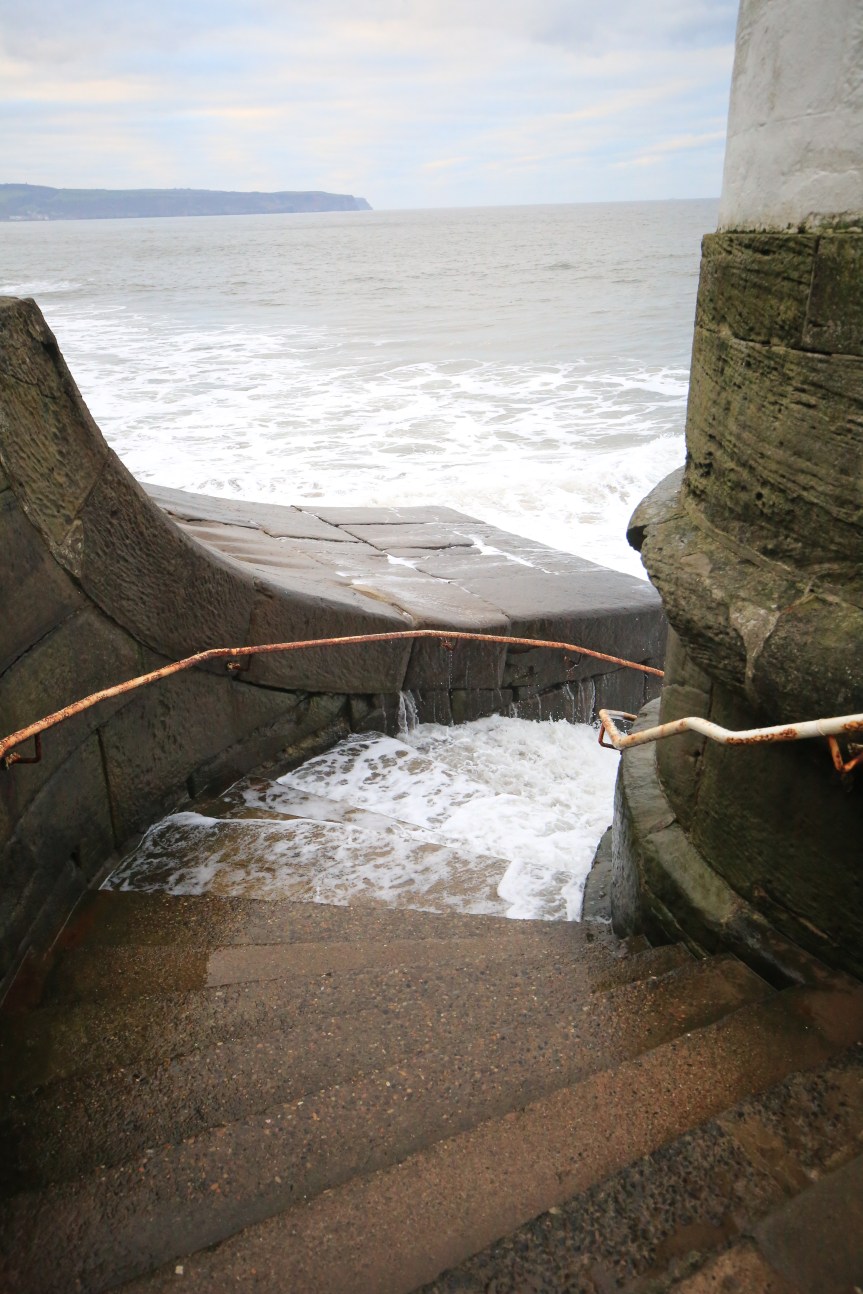
We collected ourselves and all the 6 bags that we had with us for all the eventualities of the beach life. Just before the stairs we stopped at the viewing platform to see the sea and the beach but the beach was not there to be seen. The frothy waves were licking the sea walls and all the way to the cliff. A spring high tide took over the whole beach. Disappointment was hard to swallow and yet there we were exposed to the sea air, energised by the colours of the sky, caressed by the breeze. Enough to be grateful for. Not to mention the ice-cream and the dinner and a chat with a fisherman… but more on this at a different time.





 Postcards Without Stamps